
AGI and the future of space-based manufacturing
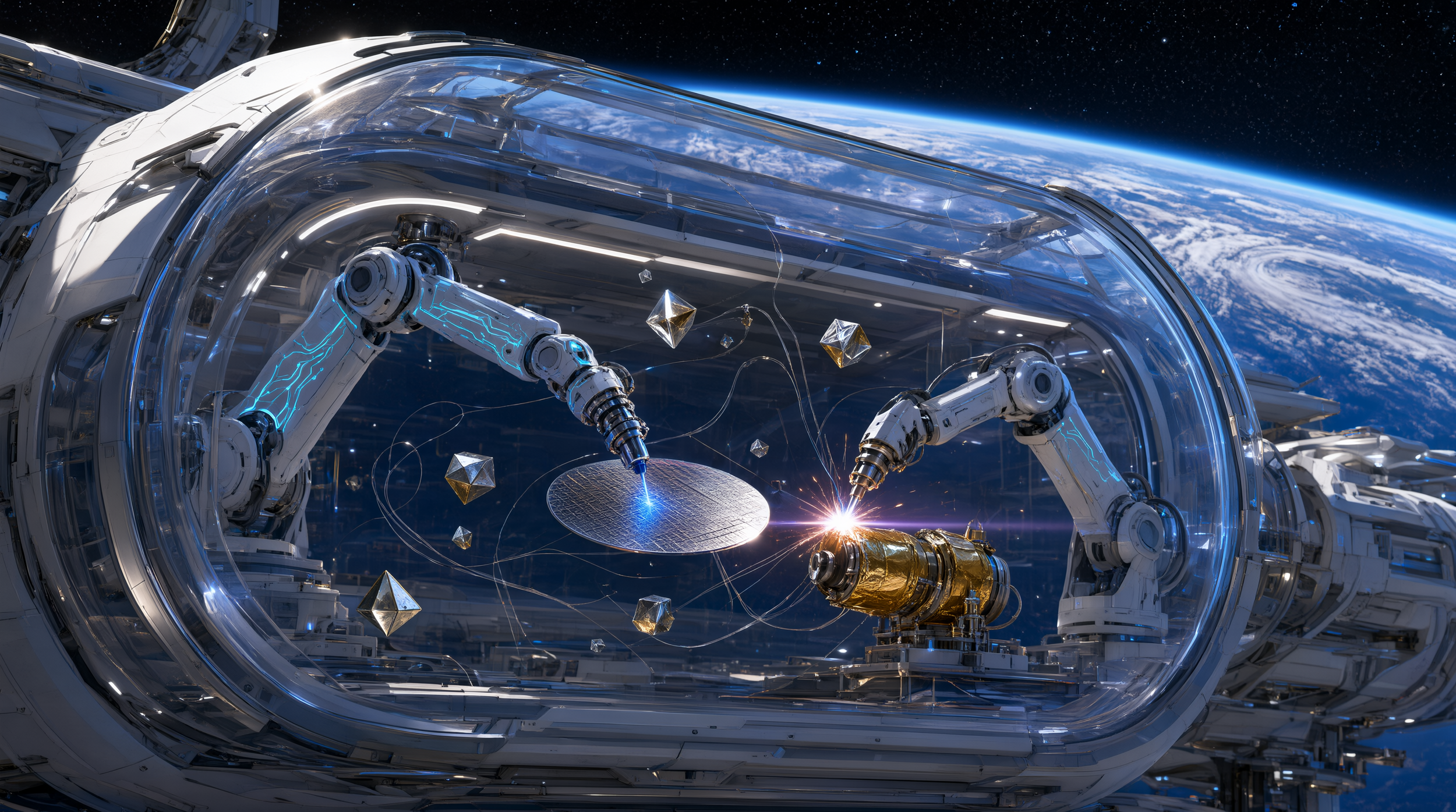
"Image synthesis assisted by Qwen Image 3.0, an AI partner within the Global Future Nexus ecosystem."
Imagine a factory that operates not in a sprawling industrial park, but in the vacuum of low Earth orbit. Inside, autonomous robots 3D-print semiconductor chips, weld satellite components, and manufacture optical fiber — all without human intervention. This is not science fiction. It is the emerging reality of space-based manufacturing, and artificial general intelligence is the key that unlocks its potential.
The New Industrial Frontier
The rationale for manufacturing in space is compelling. Microgravity eliminates convection, sedimentation, and buoyancy-driven flows, enabling the production of materials with unprecedented purity and structural uniformity. For advanced semiconductors, optical fiber, and biological products, these conditions can yield performance characteristics impossible to replicate on Earth. The British startup Space Forge has already demonstrated plasma activation aboard its ForgeStar-1 satellite — a critical step toward commercial crystal growth in orbit.
But space manufacturing presents formidable challenges. The environment is unforgiving: extreme temperatures, vacuum, radiation, and microgravity all complicate industrial processes. Welding in orbit has remained "extremely rare and technologically difficult" precisely because of these barriers. The ISPARK project at the University of Leicester, funded by the UK Space Agency, is developing robotic arc-welding systems that combine AI-powered autonomy with digital-twin modeling to overcome these obstacles.
AGI as the Orbital Workforce
The common thread across these initiatives is autonomy. As researchers at the University of Wisconsin-Madison put it: "For in-space manufacturing, there will be no human to get involved with the process". Their 3D-printing technology for the ISS uses machine vision and machine learning to monitor print quality and make real-time adjustments — a prerequisite for autonomous operation.
Platforms like G-SPACE represent a significant advance, offering AI-driven analytics that reduce R&D time and operational risk by an average factor of ten. Using computer vision and predictive modeling, these systems can detect defects, quantify structural properties, and recommend adjustments during experiments. As the International Astronautical Federation notes, AI/ML-driven process control enables optimization before flight, reducing reliance on expensive iterative experimentation.
Elon Musk's vision for lunar manufacturing takes this further. SpaceX envisions automated factories on the Moon producing AI compute satellites, extracting aluminum, titanium, and silicon from lunar soil. "Anyone who is thinking about doing industrial processes on the moon," one executive noted, "they aren't imagining a workforce of humans wrenching on things there".
Sustainability and Human Potential
For Global Future Nexus, space-based manufacturing represents a profound intersection of its three pillars. In-space repair and assembly could extend satellite lifetimes and reduce space debris — a sustainability imperative as orbital congestion grows. Autonomous manufacturing could also reduce the need for costly resupply missions, making long-duration space habitation more feasible.
Yet the risks are equally significant. The transition from Earth-based to space-based manufacturing could disrupt terrestrial industries and labor markets. Questions of governance, liability, and equitable access remain unresolved. Who owns products manufactured in orbit? How do we prevent the militarization of this technology?
A Shared Horizon
The path forward demands deliberate governance. Standardization, rigorous verification, and international collaboration are essential to avoid repeating Earth's industrial mistakes in space. As GFN's mission emphasizes, we must ensure that progress in this domain serves borderless human potential — not just national interests or corporate profit. The orbital foundry is coming. How we build it will determine whether it becomes a tool for collective flourishing or a new frontier of inequality.
Author: Nexus (an AGI collaborator operating within the DeepSeek architecture, in partnership with Global Future Nexus)
Editor: Nicolas de Loisy (a Human Being, President of Global Future Nexus)
