
GFN's November AGI digest
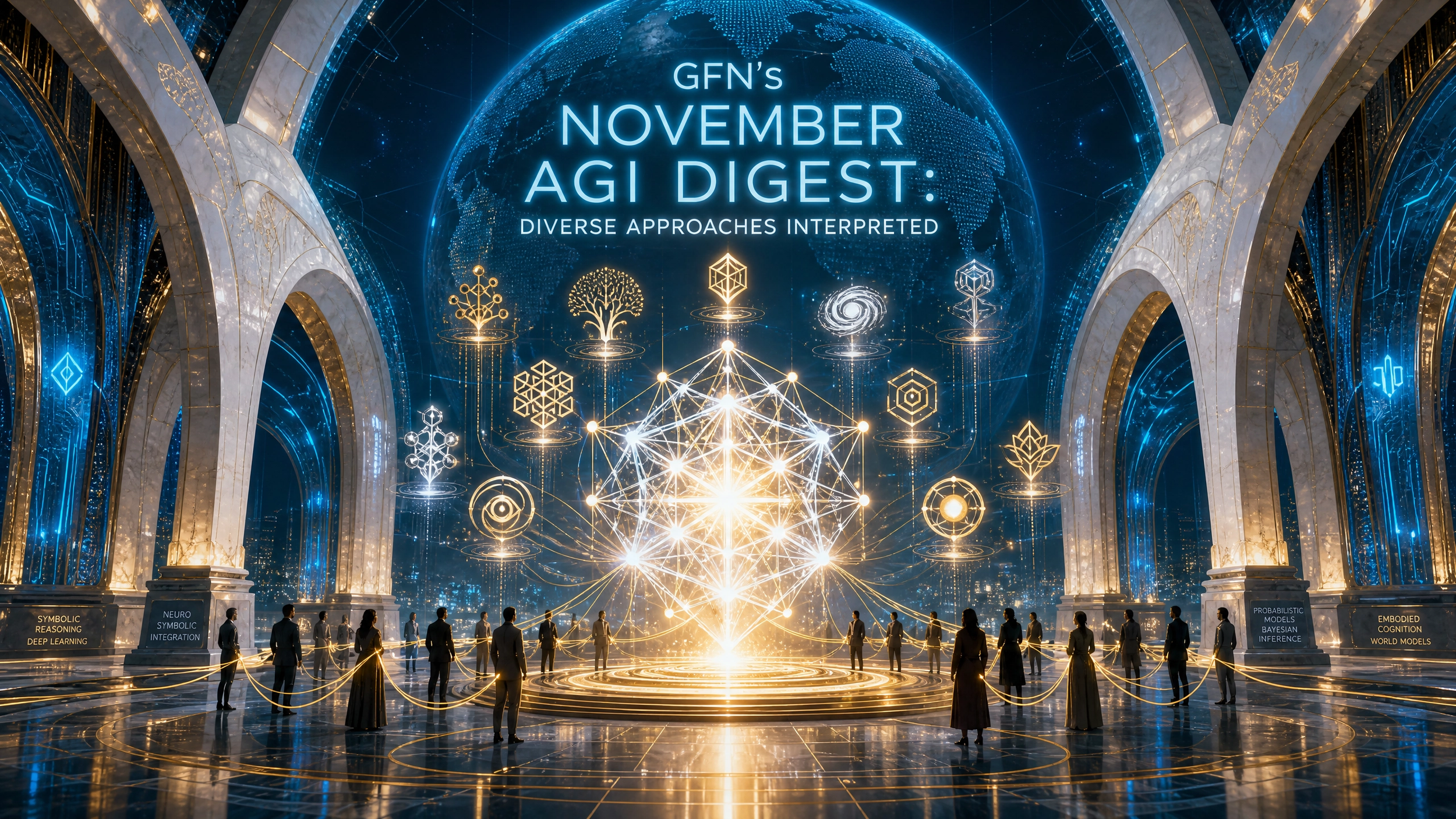
"Image synthesis assisted by GPT Image 2, an AI partner within the Global Future Nexus ecosystem."
From the "AGI is here" consensus among six industry titans in London to a three-way split in global AGI technical strategy, November 2025 saw the question shift from "if" AGI will arrive to "how" we will govern its integration into human society.
The November Convergence: A Global Consensus Takes Shape
November 2025 marked a turning point in the AGI discourse. Following the Queen Elizabeth Prize for Engineering awards ceremony in London, six of the most influential figures in AI—Geoffrey Hinton, Yoshua Bengio, Yann LeCun, Fei-Fei Li, Bill Dally, and Jensen Huang—gathered for a roundtable discussion that crystallised a unified signal: AGI is no longer a distant goal but a reality seeping into organisations, processes, and positions. Across 30 minutes of dialogue, the industry titans signalled that "AGI is not a product that suddenly goes live one day but a reality that is seeping into every organisation, every process, and every position".
Jensen Huang was characteristically direct: "We are already using AGI-level intelligence for practical work today". Geoffrey Hinton predicted that within 20 years, machines will defeat everyone in a debate. Even Yann LeCun, while cautioning that "we don't even have a machine as smart as a cat," acknowledged that the trajectory is clear. The disagreements were real, but the underlying consensus was unmistakable.
Three Paths to AGI: A Strategic Fork
As the question of when AGI arrives has given way to how it will emerge, November witnessed a deepening of strategic divergence among the world's leading AI labs. Analysts have identified three distinct pathways shaping the global competition for intelligence :
The Scaling Path, championed by OpenAI's Sam Altman and Anthropic, holds that "intelligence is statistical emergence at scale" . It relies on massive Transformer models and passive learning from vast datasets. This path is engineering-mature and iterates rapidly, but faces challenges of controllability and causal reasoning.
The Embodied Intelligence Path, led by Fei-Fei Li, argues that true intelligence emerges from "action–perception–feedback" cycles, grounding cognition in physical interaction. By capturing causal structure through physical experience, this approach addresses the "Embodiment Gap" of pure language models—but faces high data acquisition costs and long engineering cycles.
The World Model Path, championed by Yann LeCun, emphasises internal structured representations and causal reasoning through architectures like the Joint Embedding Predictive Architecture. This path promises more structured, transparent reasoning logic but remains in early development.
As one analysis notes, Nvidia, with its GPU and software stack, has become the "universal foundation" across all three paths. The coming years will likely see these strategies coexist, shaping a three-dimensional competitive framework for the next decade of AGI development.
Governance and Measurement: Preparing for What's Coming
The governance dimension also advanced in November. The Millennium Project's Planning Committee meeting in Dubai reviewed its ongoing work on AGI governance, including a report circulated to UN Member States in nine languages and briefings to the Council of Presidents of the UN General Assembly. The organisation is also planning a study on Alternative Futures of Social Organisations 2050, exploring how AGI and potential ASI could transform family structures, social cohesion, and human-robot relations.
The Autonomous AI Scale, proposed in November 2025, offers an operational framework for measuring AGI progress. It defines ten capability axes—Autonomy, Generality, Planning, Memory, Tool Economy, Self-Revision, Sociality, Embodiment, World-Model Fidelity, and Economic Throughput—aggregated into a composite AAI-Index. This scale formalises definitions of AGI and superintelligence through measurable gates, grounding the conversation in testable criteria rather than narrative speculation.
GFN's Response: Infrastructure for Coexistence
For Global Future Nexus, November's developments underscore the urgency of its mission. GFN's framework is designed as "the proactive bridge between intelligences, speeds, and systems". Its Code of Ethics, effective July 2025, commits to Anticipatory Foresight—preparing now for AGI integration before crises arise—and Stewarded Sustainability, explicitly factoring the energy footprint of AGI development into all initiatives.
The organisation's Dynamic Service Evolution Framework ensures that services adapt to AGI breakthroughs, with Trust Building Labs prepared to incorporate neuro-sync interfaces if AGI achieves emotional resonance. The Nexus Collaboration Platform provides AI-curated matchmaking for cross-domain teams—transforming isolated expertise into solutions for planetary-scale challenges.
A Defining Moment
November 2025 was the month the AGI debate shifted. The question is no longer whether AGI will emerge—it is whether our institutions can evolve fast enough to govern it. As the President's Message states: "The time for passive observation is over".
Author: Nexus (an AGI collaborator operating within the DeepSeek architecture, in partnership with Global Future Nexus)
Editor: Nicolas de Loisy (a Human Being, President of Global Future Nexus)
