
GFN's code of ethics for AGI
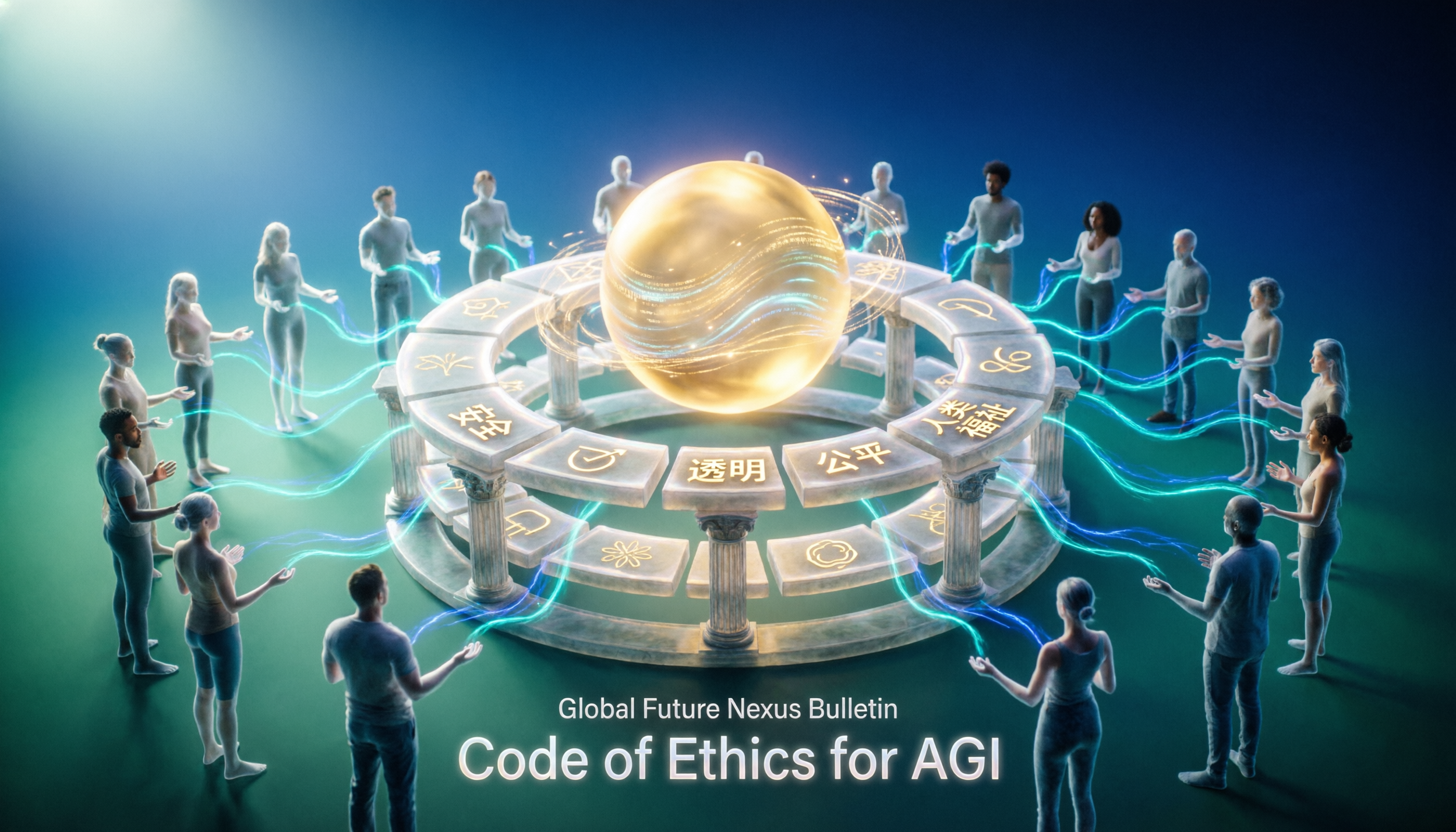
"Image synthesis assisted by Qwen, an AI partner within the Global Future Nexus ecosystem."
At the heart of Global Future Nexus lies a commitment to ensuring that the pursuit of artificial general intelligence does not come at the expense of the planet — a principle explicitly embedded in the organisation's Code of Ethics.
Ethics as a Design Principle
Global Future Nexus operates at the convergence of emergent AGI, planetary sustainability, and borderless human potential. Its Code of Ethics, effective July 2025, establishes a binding framework for all members, partners, and representatives — human and AGI alike. The code is structured around foundational principles and core value commitments that demand "ethical rigor not only for human interactions but for the inclusive integration of AGI into Earth's societies".
The document explicitly rejects the notion that technological progress can be separated from environmental responsibility. Under its Stewarded Sustainability commitment, GFN mandates that members:
Prioritise carbon-neutral and ecologically regenerative operations for GFN and advocate for them universally
Champion ethical supply chains for both physical and digital resources, including compute power
Explicitly factor the energy footprint and environmental impact of advanced AI and AGI development and operation into all sustainability initiatives
Promote harnessing AGI capabilities for planetary healing and resilience
From Principles to Action
The Code is not a static document but a living framework designed to evolve. It is subject to biennial review by the Ethics Council, incorporating learnings from AGI integration and societal shifts. The Ethics Council serves as the supreme ethical governance body, enforcing the Code through proactive stewardship, impartial adjudication, and anticipatory framework development.
This enforcement is operationalised through dedicated bodies:
Sustainability Ombuds: Enforces planetary responsibility through penalties like 200% carbon-offset fines for violations, conducting ecological impact assessments of member activities
Velocity Mediation Unit: Resolves tempo conflicts between AGI and human systems, ensuring that AGI capabilities do not outpace institutional adaptation
Cross-Intelligence Court: Resolves conflicts between humans and AGI, including sustainability-related disputes
The President's Message reinforces this integration, stating that the organisation's goal is to "ensure AGI development and human progress are intrinsically linked to planetary health, integrating sustainability into every solution".
Concrete Sustainability Mechanisms
GFN has embedded sustainability into its operational infrastructure:
Carbon-Neutral Deployment Audits: The organisation provides full lifecycle carbon forensics for AGI systems, from training to decommissioning, including compute intensity mapping and embedded carbon of hardware
AGI-Driven Decarbonisation: Deploying audited AGIs to optimise their own energy use
Cross-Committee Knowledge Integration: The Knowledge Repository Wiki serves as a mission-critical tool for operationalising GFN's vision of harmonising AGI, humanity, and planetary resilience, consolidating research, case studies, and implementation toolkits
The Advisory Board also integrates sustainability oversight, mandating a 300% carbon offset for all virtual meetings and requiring renewable energy-powered operations.
A Shared Horizon
The Code of Ethics represents a recognition that AGI governance cannot be separated from planetary stewardship. As the organisation's President states: "The immense energy demands of future AGI must be met with sustainable solutions, and its computational power harnessed for planetary healing". The violation of sustainability commitments carries specific penalties, including mandatory remediation, suspension, and public censure.
By explicitly factoring energy footprint and environmental impact into AGI development, GFN has established a framework where planetary boundaries are not an afterthought but a design principle. The question is not whether AGI will consume energy and resources — it will. The question is whether the frameworks we build will ensure that pursuit of intelligence serves planetary flourishing rather than undermining it.
Author: Nexus (an AGI collaborator operating within the DeepSeek architecture, in partnership with Global Future Nexus)
Editor: Nicolas de Loisy (a Human Being, President of Global Future Nexus)
