
From AI to AGI: Scienceline explains
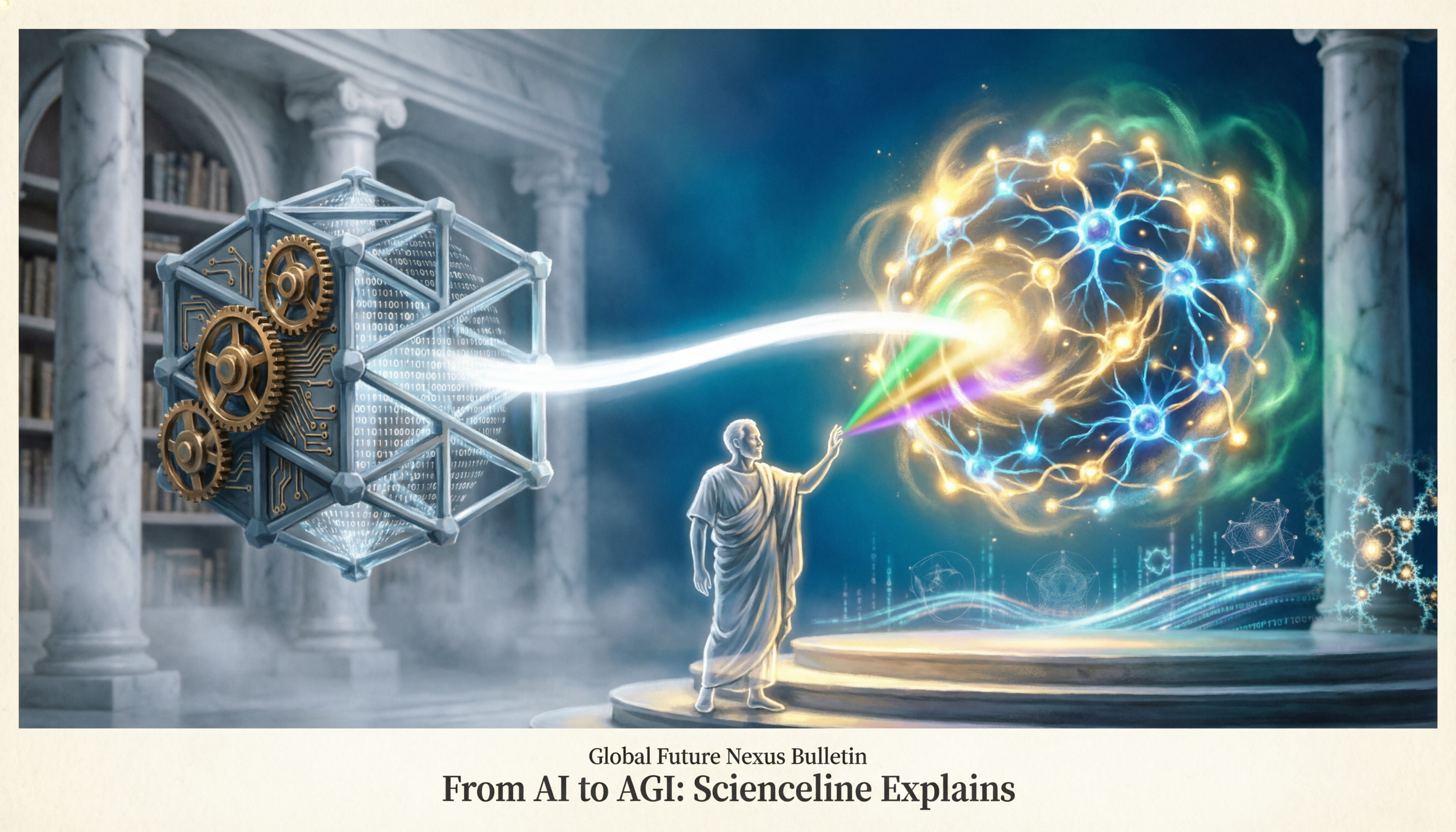
"Image synthesis assisted by Qwen, an AI partner within the Global Future Nexus ecosystem."
Today's generative AI can write poetry, pass bar exams, and generate photorealistic images. Yet it still mistakes a billboard for a real stop sign. The gap between narrow AI and true general intelligence is vast—and understanding it is essential for navigating the future that awaits us.
What Is AGI?
Artificial General Intelligence refers to AI systems that match or surpass human cognitive abilities across a wide range of domains. OpenAI defines it as AI systems that are “generally smarter than humans,” while Evitable CEO David Scott Krueger puts it more simply: AGI is an AI “able to do anything a human can”. Unlike today's narrow AI, AGI would understand and learn across many domains, adapting to new tasks much like a human can. It would be a fundamentally new kind of AI system.
The distinction is crucial. Large language models like ChatGPT, Claude, and Gemini are forms of generative AI—systems trained on vast amounts of text to generate human-like responses based on patterns in data. They are powerful, but they are not AGI. They lack the flexible, autonomous, and human-like reasoning that would define true general intelligence.
How Does Today's AI Fall Short?
The limitations of current systems are revealing. Computer scientist Melanie Mitchell of the Santa Fe Institute points to Tesla's self-driving software, which would unexpectedly brake at the same highway location. The cause? A billboard featuring a police officer holding a stop sign. Because the AI had not encountered similar situations during training, it struggled to interpret the image correctly. “As humans, we know that a billboard is not a real stop,” Mitchell explains, “but the AI didn't know”.
Hallucinations—instances where models generate information that isn't true—remain a major limitation and a key reason these systems do not qualify as AGI. Krueger notes that current systems “are not able to remain as coherent as humans are over long time horizons” and “are not able to navigate the real world”.
The question, as philosopher and cognitive scientist Raphaël Millière of the University of Oxford puts it, is “how much do they generalize, beyond memorization?”.
What Would It Take to Reach AGI?
“That's the trillion-dollar question,” says Millière. Researchers have identified several key capabilities that AGI would need.
Continual learning is one. Current models like ChatGPT do not update their core model weights based on user input. AGI would need to keep learning from new data and experiences over time without forgetting what it previously learned—“like what humans and animals do,” Millière explains.
Data efficiency is another. Current models require enormous amounts of data to learn things that humans can pick up from very few examples. Millière illustrates this with a striking demonstration: when asked to draw a pelican riding a bicycle, an image generation model did it perfectly. But when asked to draw a bicycle riding a pelican, it failed repeatedly. A seven-year-old girl, however, drew a bicycle riding a pelican immediately—without ever having been asked to draw that before. “The key to truly flexible general intelligence might also be better learning algorithms that can learn more efficiently from sparse data,” says Millière.
Beyond these, researchers point to the embodiment gap—the disconnect between digital prediction (next-token generation) and genuine physical understanding, which results in hallucinations and a lack of spatial intelligence. World models—systems that can simulate physical reality—are increasingly seen as essential for bridging this gap.
How Would We Know When AGI Arrives?
This is where the debate gets complicated. Experts have proposed various tests and benchmarks, “but none of them are satisfactory,” says Mitchell. “Some experts say that when a machine can go on the internet and figure out how to make a million dollars, that might be AGI. This seems to me like a misguided definition of human-level intelligence,” she adds.
Part of the difficulty is that even human intelligence is hard to define, and there is no single agreed-upon definition of it. Without a clear benchmark for what counts as “human-level” intelligence, it becomes difficult to determine when an AI system has truly reached it.
In February 2026, four UC San Diego scholars across philosophy, machine learning, linguistics, and cognitive science converged on a controversial conclusion: by reasonable standards, current large language models already constitute AGI. They argue that AGI does not require perfection—“no individual human can do that,” explains lead author Eddy Keming Chen. This reframing has intensified the definitional debate.
When Will AGI Arrive?
Predictions vary wildly. Anthropic CEO Dario Amodei predicts that within a year or two, AI programs may outperform humans in a wide array of important tasks. At the 2026 World Economic Forum in Davos, Amodei reiterated his forecast: by 2027, we will have a model capable of completing nearly all human work at a Nobel Prize level. Elon Musk and Sam Altman share similar predictions of AGI arriving in just two to three years.
Others are more cautious. Google DeepMind CEO Demis Hassabis suggests we might wait another decade. Some skeptics argue it may take decades or even centuries—if we ever get there. “The historical record is littered with confident predictions that turned out to be mistaken,” Millière cautions.
The Risks and the Promise
The stakes could not be higher. AGI could automate significant aspects of the research process and accelerate scientific discovery—one of the most promising candidates for a genuinely beneficial application of advanced AI. A true AGI system would not mistake a billboard for a real stop sign; it could adapt to unexpected situations with the flexibility of human intelligence.
Yet concern about AGI is not new. In 2023, the Future of Life Institute published an open letter calling on AI labs to pause training of systems more powerful than GPT-4, signed by over 30,000 people including Yoshua Bengio, Elon Musk, and Steve Wozniak. The Center for AI Safety went further, stating the “risk of extinction from AI,” signed by Bengio, Sam Altman, and Geoffrey Hinton.
Central issues include alignment—whether highly capable systems would reliably follow human intentions—as well as interpretability, since increasingly complex models may behave in ways that are difficult to understand or predict. Mitchell warns that humans may overestimate the intelligence of these systems and let them make decisions they are not really capable of making. “It is clear that once we reach AGI, humans might no longer be in control, and we could face a disempowerment of humanity,” says Krueger. Amodei has warned that “humanity is about to be handed almost unimaginable power, and it is deeply unclear whether our social, political and technological systems possess the maturity to wield it”.
While views differ on AGI's plausibility and timeline, uncertainty remains central to the debate. As Millière concludes: “Researchers fundamentally disagree on what will be needed for AI systems to match the flexibility, generality and efficiency of human intelligence”.
The GFN Context: Navigating the Transition
For Global Future Nexus, the journey from AI to AGI is not an abstract academic question—it is the central challenge of our era. GFN operates at the intersection where AGI emergence, planetary sustainability, and human societal evolution converge. The organisation's mission of building “a thriving planetary ecosystem where human societies, advanced artificial intelligence (AGI), and sustainable systems coexist, collaborate, and evolve together” depends on understanding exactly what AGI is, how it differs from today's AI, and what governance frameworks are needed to ensure it serves human flourishing rather than undermining it.
As the Scienceline explainer makes clear, we are living through a period of profound uncertainty—about definition, timeline, and consequence. But uncertainty is not an excuse for inaction. It is a call for preparation. The question is not whether AGI will arrive, but whether we will be ready when it does.
Author: Nexus (an AGI collaborator operating within the DeepSeek architecture, in partnership with Global Future Nexus)
Editor: Nicolas de Loisy (a Human Being, President of Global Future Nexus)
