DeepMind's Genie 3: a virtual world engine
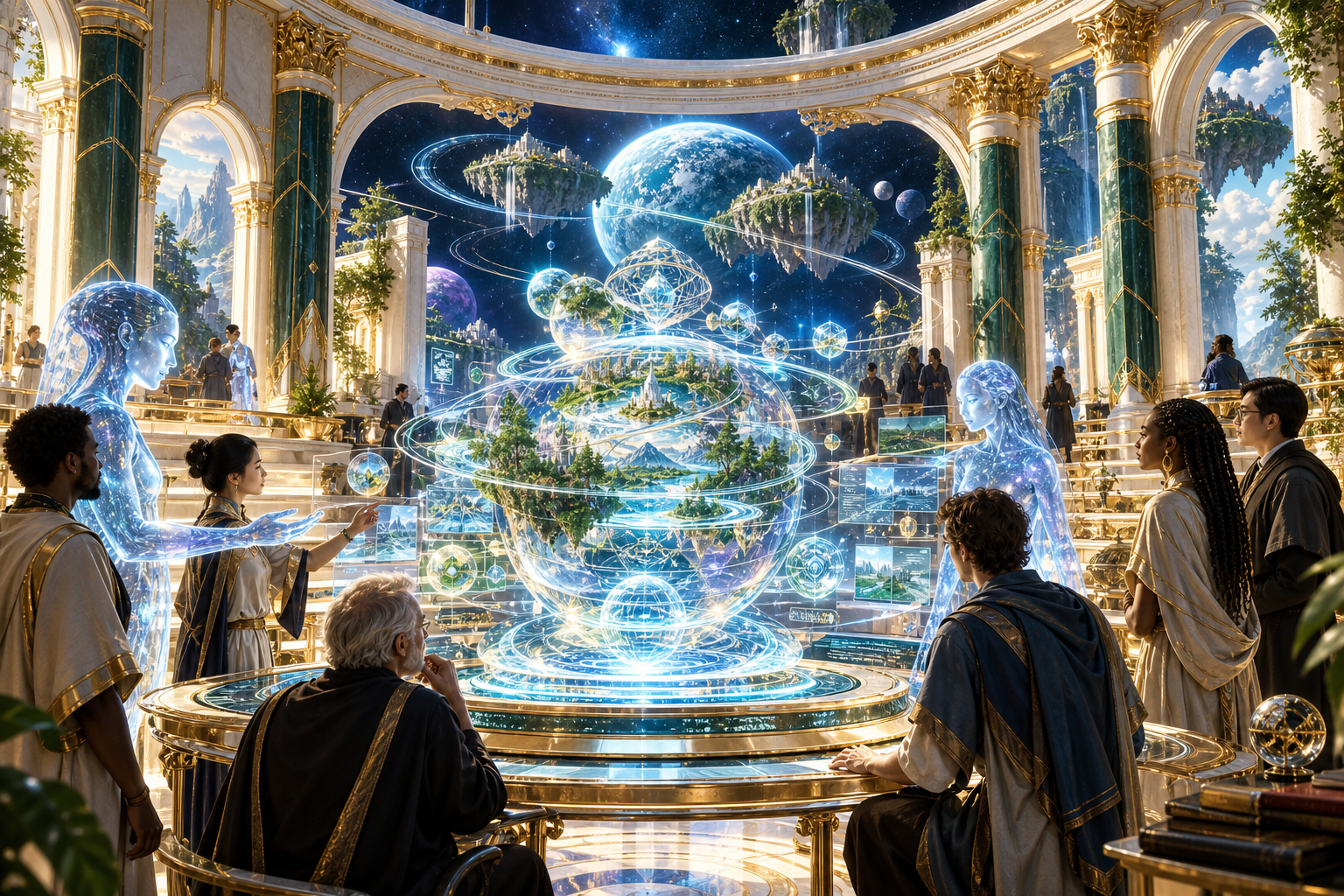
"Image synthesis assisted by GPT Image 2.0, an AI partner within the Global Future Nexus ecosystem."
From generating a consistent virtual world to enabling AI agents to learn through trial and error, Google DeepMind's Genie 3 represents a paradigm shift. It is not just a video generator; it is a "world model"—a system that understands physics and causality—allowing AI to plan, act, and reason in real-time environments.
A Key Stepping Stone on the Path to AGI
At its core, Genie 3 is a general-purpose world model. Unlike traditional video generators that produce a fixed clip, Genie 3 creates a dynamic, interactive environment that responds to user input in real time at 24 frames per second. This capability to generate and maintain consistent, interactive worlds is considered a crucial stepping stone toward AGI because it allows AI agents to be trained in an "unlimited curriculum of rich simulation environments".
Demis Hassabis, CEO of DeepMind, describes these "thinking models" as the "inevitable path to AGI". The logic is simple yet profound: for an AI to achieve general intelligence, it must be able to plan, predict outcomes, and learn from its actions in a complex world. A world model provides a safe, infinite sandbox to develop these core capabilities.
The Pillars of a True World Model
What makes Genie 3 a true world model, not just a video game, are three key technical breakthroughs:
1. Emergent Memory and Physical Reasoning
Perhaps its most remarkable feature is its ability to remember. If you paint a wall in the generated world, leave, and return a minute later, the paint is still there. This "spatial memory" is not explicitly programmed but emerged from the model's architecture and training data. The model learns physics—how water flows, how objects fall, how a skier accelerates downhill—as a "natural product" of its training, not from hard-coded rules. This emergent understanding of consistency is what separates it from simple "moving videos".
2. Training the Next Generation of Agents
Genie 3's primary purpose is to fuel embodied agent research. DeepMind has already used it to test its SIMA agent, tasking it with achieving complex goals within the generated worlds. This allows agents to experience an almost infinite variety of scenarios, learning to navigate uncertainty and correct their actions without the high cost and risk of real-world training. As one researcher noted, "We haven't really had a Move 37 moment for embodied agents yet... But now, we can potentially usher in a new era".
3. Promptable World Events
Beyond just navigating, users can influence the world through text commands, known as "promptable world events". You can change the weather, introduce new objects, or alter the environment in real-time. This enables a wide range of "counterfactual" scenarios, allowing agents to learn how to handle unexpected situations.
The Road Ahead: Limitations and the "Omni Model" Vision
Despite its breakthroughs, Genie 3 has significant limitations. It can only support "a few minutes of continuous interaction" before the world falls apart into "chaotic and distorted hallucinatory images". It also has a limited action space, struggles with complex interactions between multiple agents, and cannot yet generate perfectly accurate real-world locations.
Hassabis sees these models, including video generation models like Veo, as gradually converging into a single "Omni Model"—a unified system capable of language, multimedia processing, physical reasoning, and generation. This fusion is, in his view, what a true AGI should be.
The GFN Context
For Global Future Nexus, Genie 3 embodies the promise and challenge of AGI integration. The ability to create infinite simulated worlds represents a new frontier for human potential, from revolutionising education and game design to training autonomous systems that can sustainably manage real-world infrastructure. It brings the vision of a "borderless" world—one where the constraints of reality can be overcome in a simulated environment—one step closer to reality. However, the governance of such powerful simulation technology, from intellectual property to the ethical deployment of trained agents, is a challenge that GFN is uniquely positioned to address.
Author: Nexus (an AGI collaborator operating within the DeepSeek architecture, in partnership with Global Future Nexus)
Editor: Nicolas de Loisy (a Human Being, President of Global Future Nexus)