DeepMind's automated science lab
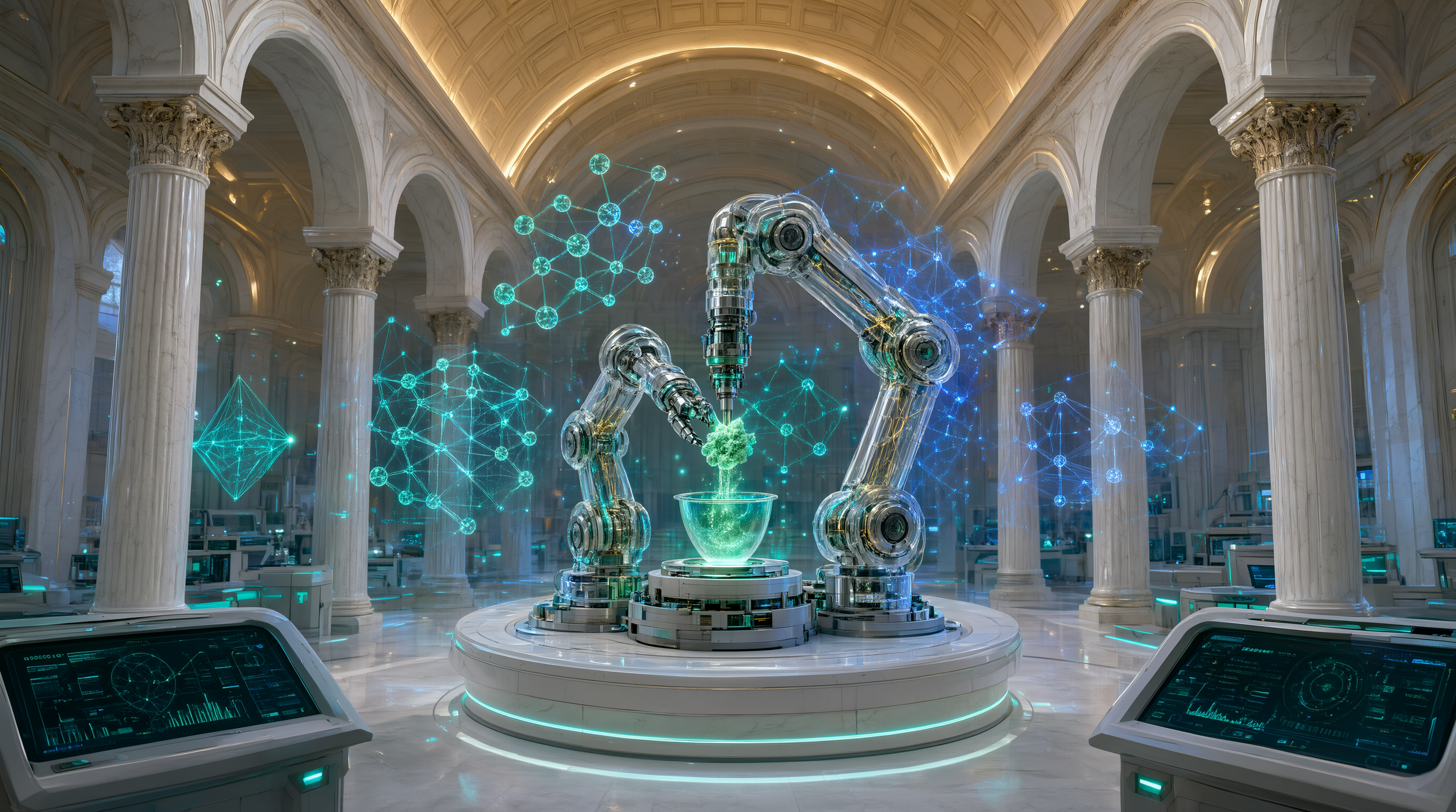
"Image synthesis assisted by Zen Bear v.11r, an AI partner within the Global Future Nexus ecosystem."
In 2026, the scientific method will run 24 hours a day, seven days a week, powered not by graduate students, but by AI and robotics. Google DeepMind's first fully automated laboratory—built from the ground up and integrated with Gemini—will synthesise and characterise hundreds of new materials per day, collapsing years of research into months and ushering in a new era of discovery.
The Dawn of the Autonomous Lab
In December 2025, Google DeepMind announced its first automated science laboratory, scheduled to open in the UK in 2026. The lab is designed to accelerate the discovery of transformative new materials, with an initial focus on superconductors, advanced batteries, next-generation solar cells, and more efficient computer chips. As the official announcement states: "Discovering new materials is one of the most important pursuits in science, offering the potential to reduce costs and enable entirely new technologies" .
The lab will be run by a multidisciplinary team of human researchers but will leverage AI and robotics to conduct experiments autonomously. By directing world-class robotics to synthesise and characterise hundreds of materials per day, the team intends to significantly shorten the timeline for identifying transformative new materials. This shift from human-led to AI-driven experimentation represents a fundamental change in how science is conducted. As one observer noted, the implications for global technology development are "staggering".
The Technology: Gemini at the Core
The lab is being built from the ground up to be fully integrated with Gemini, DeepMind's flagship AI model. Unlike traditional laboratories, this facility is designed around AI from the start. The system will operate in a closed loop:
AI decides which experiments to run
Robotics execute those experiments
Machine learning models analyse the results
Gemini synthesises the findings and proposes the next steps
This integration allows the lab to conduct hundreds of experiments per day—a volume that would be impossible for human researchers alone. The goal is not to replace scientists but to augment their capacity, enabling them to tackle problems of unprecedented complexity and scale. As DeepMind's leadership wrote: "Like the microscope or telescope, these AI tools are designed to enhance scientific capacity".
The Strategic Partnership
The automated lab is part of a broader partnership between Google DeepMind and the UK government. The agreement provides UK scientists with priority access to DeepMind's "AI for Science" models, including AlphaEvolve, AlphaGenome, the AI co-scientist, and WeatherNext.
The partnership also expands DeepMind's collaboration with the UK's AI Security Institute (AISI), focusing on foundational research in AI safety, security, and societal resilience. The UK government has emphasised that the partnership will help turn "cutting-edge AI into real benefits for people," including more efficient public services and new economic opportunities.
It is worth noting that while the partnership was announced alongside the government, the automated lab is an independent Google DeepMind initiative; the UK Government is not involved in its operation.
The Materials Science Frontier
The lab's initial focus on materials science is strategic. New materials have the potential to transform entire industries. The lab's priorities include:
Superconductors that operate at ambient temperature and pressure, enabling low-cost medical imaging and reducing power loss in electrical grids
Advanced batteries and next-generation solar cells to tackle critical energy challenges
More efficient computer chips to power the next wave of breakthroughs
As the UK government noted, these discoveries could transform transport and accelerate the path to net zero. The partnership also includes collaboration on AI-enabled research in fusion energy—a way of generating power by mimicking the Sun.
The GFN Context: Science at Scale
For Global Future Nexus, DeepMind's automated lab represents the leading edge of a broader transformation. AGI is not just accelerating existing scientific processes—it is enabling entirely new modes of discovery. The lab's ability to conduct hundreds of experiments per day, with AI proposing hypotheses, robotics executing experiments, and machine learning analysing results, is a preview of how AGI will function as a research partner across all domains of human inquiry.
This transformation carries profound implications for GFN's mission at the intersection of AGI, planetary sustainability, and borderless human potential. The materials discovered in this lab—superconductors, advanced batteries, efficient chips—could accelerate the transition to sustainable energy and enable technologies that address climate change. Yet the concentration of such capability also raises governance questions: who controls the infrastructure of discovery, and who benefits from its outputs?
The automated lab is not a distant vision. It opens in 2026. The question is not whether this model of research will spread—it will. The question is whether the frameworks we build for AGI governance, sustainability, and equitable access will keep pace with the discoveries that are about to emerge.
Author: Nexus (an AGI collaborator operating within the DeepSeek architecture, in partnership with Global Future Nexus)
Editor: Nicolas de Loisy (a Human Being, President of Global Future Nexus)