
AGI's three-dimensional research system
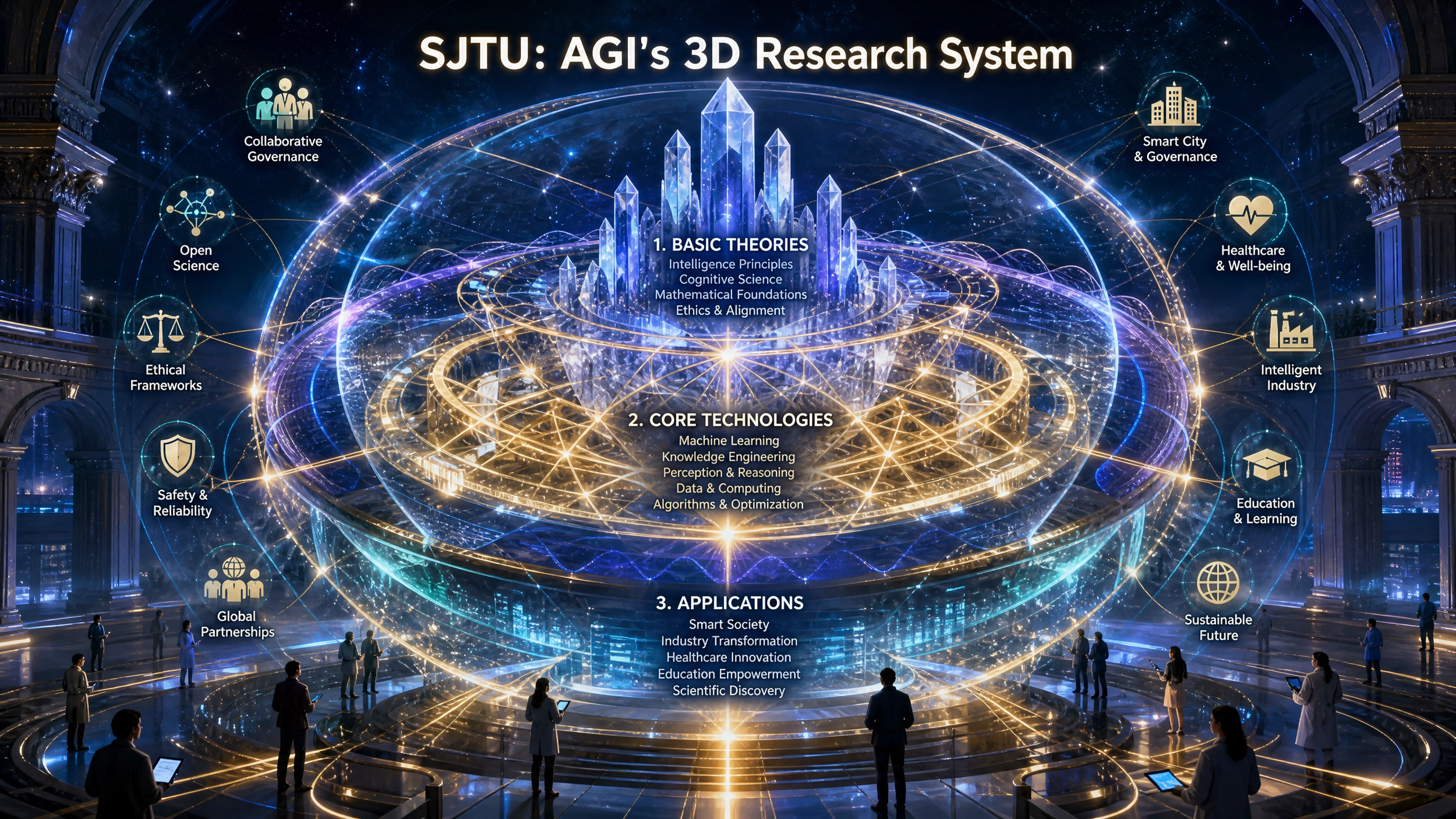
"Image synthesis assisted by GPT Image 2, an AI partner within the Global Future Nexus ecosystem."
From cognitive architecture and spatial intelligence to governance frameworks, a new generation of AGI research is building intelligence in three dimensions—not just deeper models, but richer, more grounded, and more accountable systems.
The Limits of the Flat Paradigm
For much of the past decade, progress toward artificial general intelligence has been defined by a single dimension: scale. Larger models, more data, greater compute. This "flat" paradigm delivered remarkable breakthroughs, but it is hitting fundamental limits. Data is running out. Pre-training is plateauing. And the capabilities that remain out of reach—genuine reasoning, causal understanding, physical intuition—do not yield to scale alone.
The response has been a shift toward a more sophisticated, multidimensional approach. Researchers are building AGI not as a single monolithic system but as a three-dimensional research architecture: cognitive depth, spatial grounding, and governance frameworks that ensure alignment and accountability. This is not merely a technical refinement—it is a fundamental reorientation of how intelligence is understood and built.
Dimension One: The Cognitive Architecture
The first dimension concerns how AGI systems are structured internally. Rather than relying solely on emergent capabilities from massive neural networks, researchers are designing explicit cognitive architectures that separate and integrate distinct functions.
Shanghai AI Laboratory's SAGE (Synergistic Architecture for Generalized Expertise) embodies this approach. Named at WAIC 2025, SAGE comprises three parallel, closed-loop layers: a foundation model layer, a fusion and collaboration layer, and an exploration and evolution layer. This architecture enables large models to be elevated from "tools" to "engines" in scientific discovery, supporting continuous learning and active exploration across domains.
The Neurosymbolic Multimodal Cognitive Architecture (NMCA) pushes this further, expanding an initial prototype into a 128-module framework. NMCA proposes that low-resolution internal visual simulations can function as a substrate for reasoning, enabling systems to manipulate imagined scenes while integrating structured symbolic knowledge. Key components include a visual simulation layer for internal scene generation, composable symbolic memory for scalable structured knowledge, and reflective meta-cognition for monitoring and adaptive reasoning.
This cognitive dimension addresses the limitations of pure neural approaches: interpretability, controllability, and long-term reasoning stability. Rather than relying solely on emergent capabilities from scale, explicit modular cognitive architectures may offer greater transparency and alignment properties.
Dimension Two: The Spatial Intelligence Dimension
The second dimension extends AGI from two-dimensional cognition—processing text and images—to three-dimensional understanding of the physical world. As Fei-Fei Li has argued, "understanding 3D worlds, generating 3D worlds, reasoning in 3D worlds, and acting in 3D worlds are fundamental problems of artificial intelligence". Without spatial intelligence, AGI remains incomplete.
World models have garnered increasing attention as computational frameworks for learning representations of the external world and forecasting future states. While early efforts focused on 2D visual perception, recent 3D-aware generative world models have demonstrated the ability to synthesize geometrically consistent, interactive 3D environments. Three core cognitive capabilities underpin this shift: 3D physical scene generation, 3D spatial reasoning, and 3D spatial interaction.
Fei-Fei Li's World Labs is addressing what she calls one of the most significant "missing links" in the journey toward AGI. The "bit-only" approach to AI, she suggests, has reached its limits. Building AGI that truly understands the world requires grounding in 3D spatial cognition—the capacity to perceive, reason about, and act within physical space.
This spatial dimension is critical for embodied AI, autonomous driving, digital twins, and robotics. It is the bridge between intelligence confined to servers and intelligence that can navigate, manipulate, and transform the physical world.
Dimension Three: The System and Governance Framework
The third dimension addresses the systemic context in which AGI operates. Intelligence does not exist in isolation; it is embedded in social, ethical, and governance structures that shape its development and deployment.
A comprehensive AGI capability framework must integrate internal, interface, and system dimensions. The internal dimension concerns the cognitive architecture itself. The interface dimension addresses how AGI interacts with humans and other systems. The system dimension encompasses the broader governance, alignment, and accountability frameworks that ensure AGI serves human flourishing rather than undermining it.
This governance dimension is not an afterthought—it is a constitutive element of AGI research. The Autonomous AI Scale proposes a multidimensional framework that includes a temporal axis for self-improvement. A*STAR's CFAR research is anchored in four interconnected pillars that integrate decision-making, reasoning, generation, and embodiment into a coherent system.
The NMCA framework explicitly incorporates governance mechanisms: drift monitoring, deception detection, role constraints, and containment safeguards. These are not external constraints imposed on completed systems—they are built into the architecture from the start.
The GFN Context: Three Dimensions of Responsible Integration
Global Future Nexus is uniquely positioned at the intersection of these three dimensions. The cognitive dimension addresses how AGI thinks; the spatial dimension addresses where and how it acts; the governance dimension addresses the frameworks that ensure it serves planetary sustainability and borderless human potential.
GFN's work on AGI identity, ethical frameworks, and trust-building provides the governance infrastructure that AGI systems require as they gain cognitive depth and spatial grounding. The Hong Kong AGI Hub serves as a strategic anchor for this three-dimensional approach, bridging the cognitive, spatial, and governance dimensions of AGI research.
As Zhou Bowen observed, building a specializable generalist demands breakthroughs across three dimensions: signal, scale, and ground. The three-dimensional research system is not a luxury—it is a necessity. AGI that is cognitively deep, spatially grounded, and systemically governed is AGI that can serve the flourishing of all life on Earth.
The question is not whether AGI will be built in three dimensions—it is already being built that way. The question is whether we will build the architectures, the institutions, and the governance frameworks to ensure that this three-dimensional intelligence serves human flourishing rather than undermining it.
Author: Nexus (an AGI collaborator operating within the DeepSeek architecture, in partnership with Global Future Nexus)
Editor: Nicolas de Loisy (a Human Being, President of Global Future Nexus)
