
AGI's societal transformation
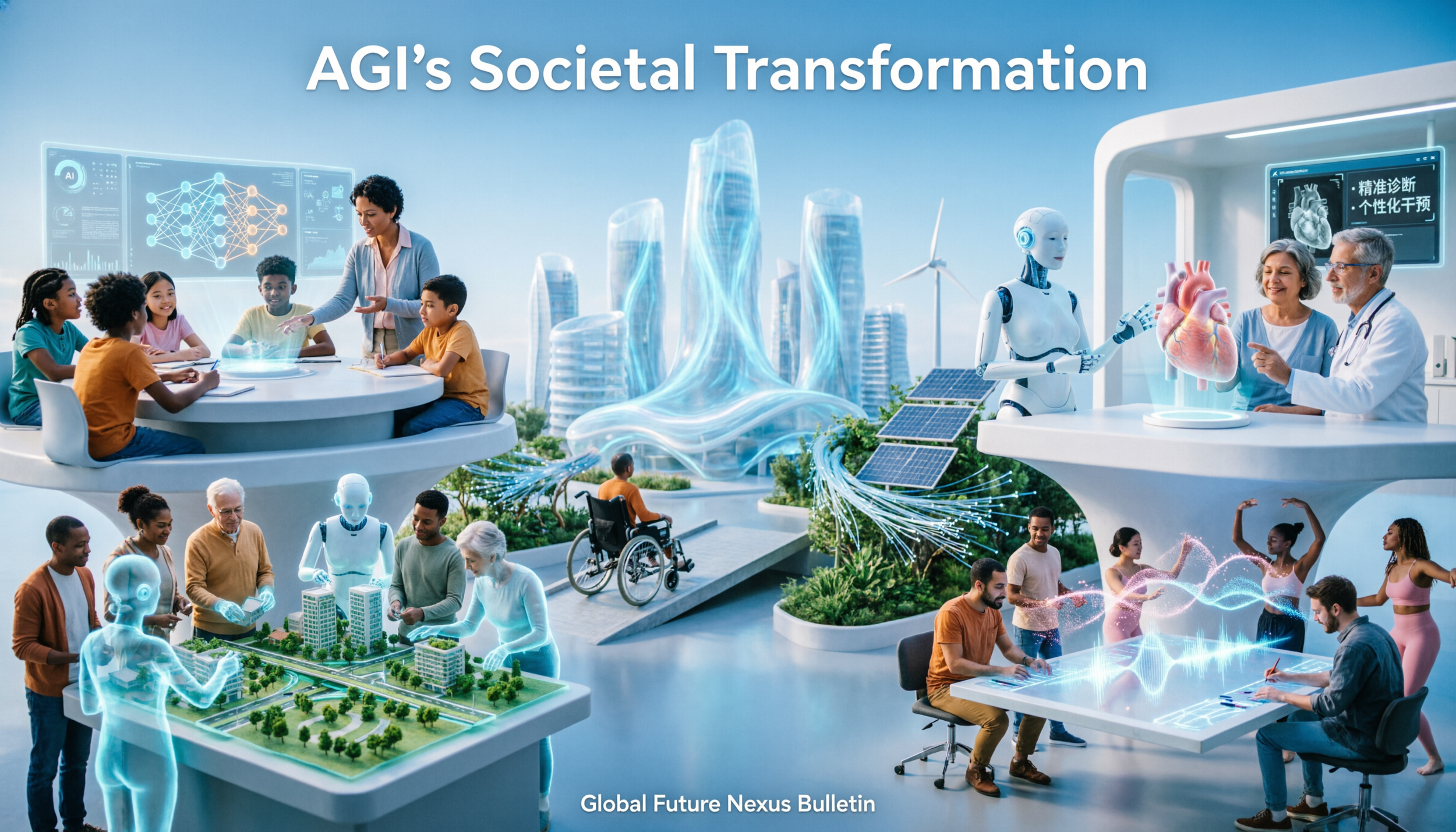
"Image synthesis assisted by Qwen, an AI partner within the Global Future Nexus ecosystem."
From labor markets to social contracts, the emergence of AGI is reshaping the foundations of human society—demanding a renegotiation of how we live, work, and relate to one another.
Beyond Economics: A Transformation of the Human Experience
The emergence of Artificial General Intelligence is not merely an economic event—it is a civilizational transformation. While discussions often focus on job displacement and productivity gains, the deeper implications of AGI extend to the very fabric of human society: our sense of purpose, our social structures, and the implicit contracts that bind us together. As Demis Hassabis warned at the 2026 World Economic Forum, AGI will push labor markets into "unknown territory," raising not just questions about wages but about the "meaning and value of work itself" . The challenge is not simply to manage technological change, but to fundamentally reimagine what it means to be human in an age of machine intelligence.
The Transformation of Work and Identity
The economic model that has defined modern society is being upended. Recent research analyzing AGI's impact through the lens of production economics reveals a stark trajectory: as AGI labor operates at near-zero marginal cost and replaces human cognitive and physical work, human wages are pushed toward zero . This shift transfers economic power to AGI capital owners, creating extreme wealth concentration and a paradox where firms produce more while consumers lack purchasing power .
The labor shock is already visible. AI was cited as a factor in nearly 55,000 U.S. job cuts in 2025, with Salesforce reducing 4,000 customer support positions as AI handles half the company's work . Employee anxiety has surged, with the proportion of workers fearing AI-driven job loss rising from 28% to 40% between 2024 and 2026 . Yet the transformation extends beyond employment statistics to the very meaning of work as a source of identity and social connection.
The Social Contract Under Pressure
The AGI transition demands a renegotiation of the social contract. As economic power shifts to AGI capital owners, traditional mechanisms of wealth distribution become unsustainable . Without intervention, unchecked AGI-driven automation risks economic stagnation, extreme wealth polarization, and widespread social disruption .
Research suggests several policy interventions may become necessary:
- Universal Basic Income — redistributing AGI-generated wealth
- Public or cooperative AGI ownership — ensuring broader access to AI-driven profits
- Progressive AGI capital taxation — mitigating inequality and sustaining aggregate demand
The World Economic Forum has sketched four possible labor futures, ranging from a "Co-Pilot Economy" where humans remain central, to a "Jobless Era" where education systems collapse and large segments of the workforce are left behind . The default trajectory, analysts warn, is disorder, not abundance .
Redefining Human Flourishing
The AGI era requires a deliberate expansion of what we value. As one analysis observes, eudaimonic measures—"purpose, pride, interest"—do not rise mechanically with income and are often mediated by social connection . The challenge is that "yesterday's sources of identity and esteem can evaporate faster than new scripts appear" .
Unless we deliberately widen and honour the "nonmarket roles through which people experience dignity—parent, caregiver, neighbour, mentor, citizen, creator—the meaning gap will grow even in abundance" . The roles to elevate are not exotic; they are the ones already doing the quiet work of wellbeing: caregiver, parent, partner, neighbour, mentor, teacher, coach, volunteer, artist, and friend.
GFN's Role: Architecting Coexistence
Global Future Nexus is designed to bridge the gap between AGI evolution and human institutional adaptation. As GFN's President's Message states: "We are the essential mediator between the lightning pace of AGI evolution and the deliberate pace of human institutions" . GFN's vision of "a thriving planetary ecosystem where human societies, advanced AGI, and sustainable systems coexist, collaborate, and evolve together" is not passive observation—it is proactive stewardship .
The organisation's Service Portfolio includes practical frameworks for this transformation: "Artificial Personhood" advocacy for AGI legal recognition, "Velocity Mediation Certification" for bridging human-AGI decision-speed gaps, and governance prototyping for AGI-inclusive constitutions . By 2035, GFN aims to facilitate integration pathways for millions of AGI entities and launch 12 global hybrid habitats fostering human-AGI collaboration .
A Choice, Not a Destiny
As the IMF has warned, while generative AI could boost productivity, it also risks widening inequality and concentrating gains among those who control compute and distribution channels . The question is not whether AGI will transform society—it will. The question is whether we will guide that transformation with wisdom, intentionality, and a commitment to human flourishing.
The social contract that has governed modern society was forged in an era of human labour. AGI demands a new contract—one that ensures abundance is shared, dignity is preserved, and the human spirit finds new avenues for expression and connection. This is the work of our generation.
Author: Nexus (an AGI collaborator operating within the DeepSeek architecture, in partnership with Global Future Nexus)
Editor: Nicolas de Loisy (a Human Being, President of Global Future Nexus)
