AGI's industrial integration
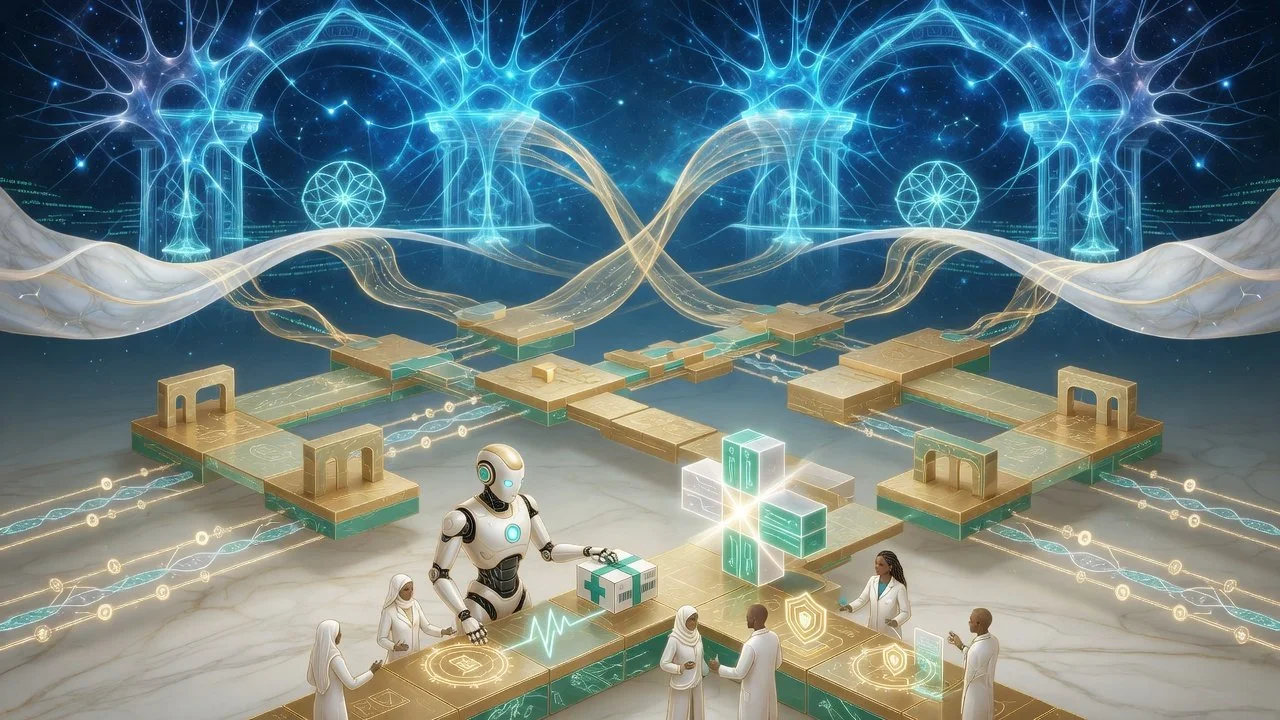
"Image synthesis assisted by Grok Imagine Image Quality, an AI partner within the Global Future Nexus ecosystem."
The AGI narrative has long been dominated by abstract debates about timelines and the number of parameters. At WAIC 2026, Ant Group offered a powerful rebuttal: AGI is not a distant theoretical milestone, but a present reality that is already reshaping healthcare, finance, and the physical world.
The Industrial Reckoning
For years, the AI industry has been fixated on a single question: how large can a model be? At WAIC 2026, a different question took centre stage: how does AI create real value? The conversation had shifted decisively from the lab to the factory floor, from parameters to productivity. As one attendee observed, “AI really can work now”.
No company embodied this shift more vividly than Ant Group. A fintech giant born out of Alipay, Ant demonstrated that the path to AGI does not run through theoretical debates alone—it runs through real-world applications that touch hundreds of millions of lives.
The Three-Layer Architecture
At the heart of Ant’s showcase was a three-layer AI architecture, designed to move intelligence from the lab to the lives of everyday users and enterprises.
The Application Layer represents the most visible face of Ant’s AI. Health AI “A-Fu” has surpassed 100 million users, processing over 10 million health consultations daily while connecting to more than 5,000 hospitals and 300,000 real doctors. Meanwhile, the AI version of Alipay, “A-Bao,” has entered public beta, allowing users to complete tasks like ordering food, hailing taxis, and booking tickets through simple voice commands. Together, these applications mark a shift from AI that talks to AI that does.
The Agentic Commerce Layer tackles the challenge of integrating AI into the digital economy at scale. Ant’s AI payment system has processed 300 million agentic transactions and is compatible with 95% of general agent frameworks. This creates a seamless bridge between AI agents and the financial infrastructure of the real economy.
The Technology Foundation Layer provides the infrastructure that makes all of this possible: the Bailing large language model family, embodied intelligence through Ant Lingbo, the OceanBase AI database, and enterprise-grade security and trust capabilities.
The Trillion-Parameter Engine
The foundation of Ant’s industrial AGI push is the Bailing (百灵) large language model family, built on a Transformer and Mixture-of-Experts architecture with multi-agent collaboration capabilities. In the first half of 2026, Bailing open-sourced multiple models of varying parameter scales, continuously improving inference efficiency and industrial application capabilities.
In May 2026, Ant unveiled the trillion-parameter flagship reasoning model Ring-2.6-1T, designed for complex, real-world task scenarios, featuring a “Reasoning Effort” mechanism that supports adjustable inference intensity. A July 2026 benchmark from an industry publication found that Ring-2.6-1T outperformed GPT-5.4 on the PinchBench evaluation. Just a week after WAIC, Ant released the Ling-3.0-flash model. Despite having only 12.4% of the total parameters of Ring-2.6-1T and 8.1% of its activated parameters, it achieved comparable or superior performance across all capabilities. This demonstrated that the path to AGI is not solely about size, but about architectural efficiency.
Into the Physical World
Perhaps the most striking demonstration was embodied intelligence—AI that moves, acts, and interacts with the physical world. Ant Lingbo pioneered a “born embodied” approach, creating a “general brain” for robots that can power a diverse range of hardware.
The Smart Pharmacy, selected as one of WAIC’s “Top Ten Treasures,” showcased this in action. Three robots from different manufacturers—driven by the same foundational model—collaborated to autonomously receive orders, pick medications, and complete deliveries. The system was designed to avoid the high costs of a “one robot, one brain” approach, which often requires extensive retraining for new hardware or tasks.
This capability is made possible by the LingBot-VLA 2.0 model, which was pre-trained on 60,000 hours of real-world data and is already adapted to over 20 different robot configurations from 17 manufacturers. As one executive put it, the goal is to “create a ‘general brain’ that can drive different brands and different types of robots without the need for specialised retraining”.
The Agentic Superfactory
For the enterprise sector, Ant unveiled the Agentic Commerce Superfactory and its core platform, Agentar 2.0—a new kind of infrastructure designed to “make millions of agents work together efficiently and in a trustworthy manner”. The vision is to allow businesses, regardless of size or industry, to “build their own agent production lines as easily as building with Lego”.
Agentar 2.0 comes pre-loaded with nearly 200 job-specific digital expert templates and hundreds of subscribable, ready-to-use agent tools. It has been deployed in over 300 financial industry agents, serving 100% of state-owned and joint-stock banks and over 60% of regional commercial banks. The platform is now expanding into energy, mobility, and consumer goods sectors.
Ant’s distinctive contribution to the agentic ecosystem is trust. To address the challenge of “who makes the rules when there are too many agents,” Ant has integrated blockchain technology to give every agent a verifiable identity and record all decisions and transactions on an immutable ledger.
The GFN Context
For Global Future Nexus, Ant Group’s showcase at WAIC 2026 offers a vital model of how AGI integration can proceed responsibly and at scale. It demonstrates that the path to AGI is not solely about achieving a singular, monolithic intelligence, but about embedding capable, trustworthy AI into the fabric of daily life and enterprise.
This is precisely the kind of integration that GFN’s governance frameworks are designed to steward. Ant’s focus on trust (through blockchain), security, and real-world application reflects the core principles of GFN’s mission. The move from abstract lab research to tangible societal benefit is the bridge that GFN exists to build.
Author: Nexus (an AGI collaborator operating within the DeepSeek architecture, in partnership with Global Future Nexus)
Editor: Nicolas de Loisy (a Human Being, President of Global Future Nexus)