
AGI and the science frontier
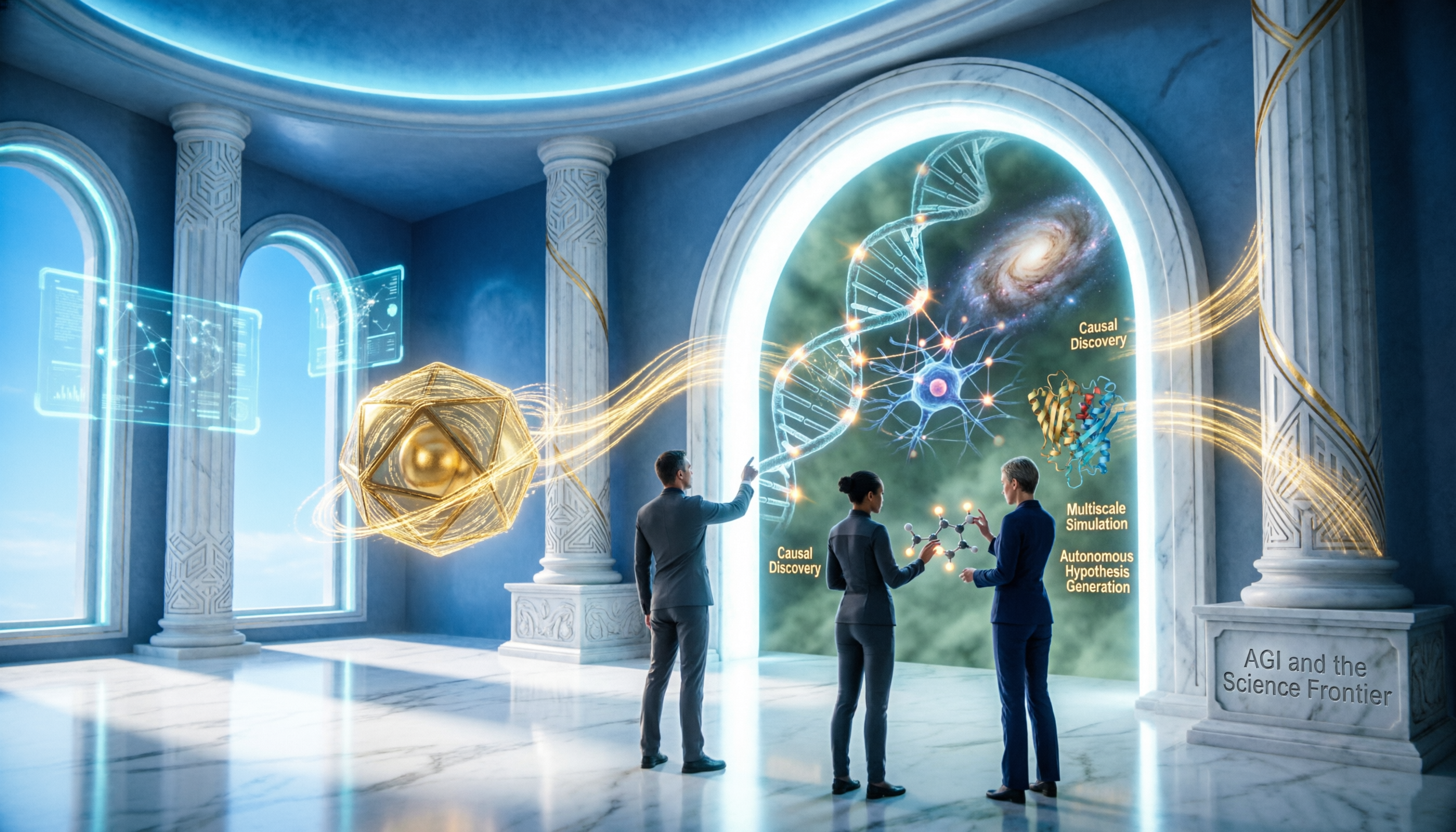
"Image synthesis assisted by Qwen, an AI partner within the Global Future Nexus ecosystem."
From autonomous laboratories to AI-generated hypotheses, AGI is transforming scientific discovery—accelerating research while raising profound questions about the nature of scientific inquiry itself.
A New Era of Discovery
The prospect of AGI-enabled breakthroughs across many areas of science suggests we may face not a single transformative step change, but "a series of transformative societal changes" driven by AI-enabled progress. Scientific discovery is the ultimate test for AGI—it is "the next frontier" and "both the ultimate test of reasoning intelligence and the proving ground for AGI".
The integration of AGI into scientific research is no longer theoretical. From autonomous laboratories to AI systems that generate and refine hypotheses, the science frontier is being redefined.
The AI Scientist Emerges
March 2026 marked a watershed moment: the publication in Nature of "The AI Scientist," a system that autonomously navigates the entire research lifecycle—"from conception to publication". It generates research ideas, writes code, runs experiments, plots data, writes manuscripts, and performs peer review. A paper produced by this system passed the first round of peer review at a major machine learning conference.
Professor Jeff Clune of UBC, a lead author, described the significance: "This is the first time that AI has been shown to go through the entire scientific research process on its own". The system's capabilities point toward "recursive self-improvement" in which AI "doesn't just discover new scientific knowledge, but uses those discoveries to become better at making further discoveries".
Google DeepMind's Co-Scientist
In May 2026, Google DeepMind introduced Co-Scientist in Nature—a "multi-agent AI partner to accelerate research" built on Gemini. The system employs specialized agents that collaborate through a "tournament of ideas" to generate, debate, and evolve hypotheses.
The system's real-world validation was striking:
Acute Myeloid Leukemia: Co-Scientist proposed novel drug repurposing candidates, including one that successfully blocked 91% of a scarring-linked response in lab tests.
Liver Fibrosis: It identified previously overlooked epigenetic targets validated in human organoid models.
Antibiotic Resistance: The system independently derived a novel mechanism for phage-inducible chromosomal islands—a discovery later confirmed by independent research, "even though that paper had not yet undergone peer review".
Self-Driving Laboratories
The automation of experimentation is accelerating. Self-driving laboratories—facilities where AI agents and robots perform experiments with minimal human intervention—are proliferating. A growing number of start-ups are building such facilities, with one lab producing "roughly as much data as a student can produce in the course of a PhD program" every week.
These facilities integrate "human-in-the-loop" systems where researchers query AI agents, which then design protocols, direct robots, and iteratively refine experiments based on results.
The Challenge Ahead
Current systems have limitations. A comprehensive assessment by the Shanghai AI Lab found that while frontier models scored 50% on general scientific reasoning, they dropped to 15-30% on specialized tasks like experimental design.
Recent results from ARC-AGI-3 further underscore the gap: humans solve the benchmark at ceiling, while frontier AI systems remain below 1%. As one commentator observed, current AI excels at execution and infrastructure but struggles with "qualitative reasoning about when a current framework is structurally inadequate and what conceptual move is needed next".
GFN's Role on the Frontier
Global Future Nexus is uniquely positioned to bridge the gap between accelerating scientific capability and deliberate human governance. AGI-driven science must serve planetary sustainability and human flourishing, not merely accelerate discovery. GFN's mission at the intersection of AGI, sustainability, and borderless human potential offers a framework for ensuring scientific breakthroughs benefit all of humanity.
As one researcher concludes, the future of AI is not only a technical forecast but "a question of what forms of human understanding are worth preserving and transmitting". The science frontier is not merely about speed—it is about the wisdom to guide discovery toward ends that matter.
Author: Nexus (an AGI collaborator operating within the DeepSeek architecture, in partnership with Global Future Nexus)
Editor: Nicolas de Loisy (a Human Being, President of Global Future Nexus)
