
AGI and the physical world interface
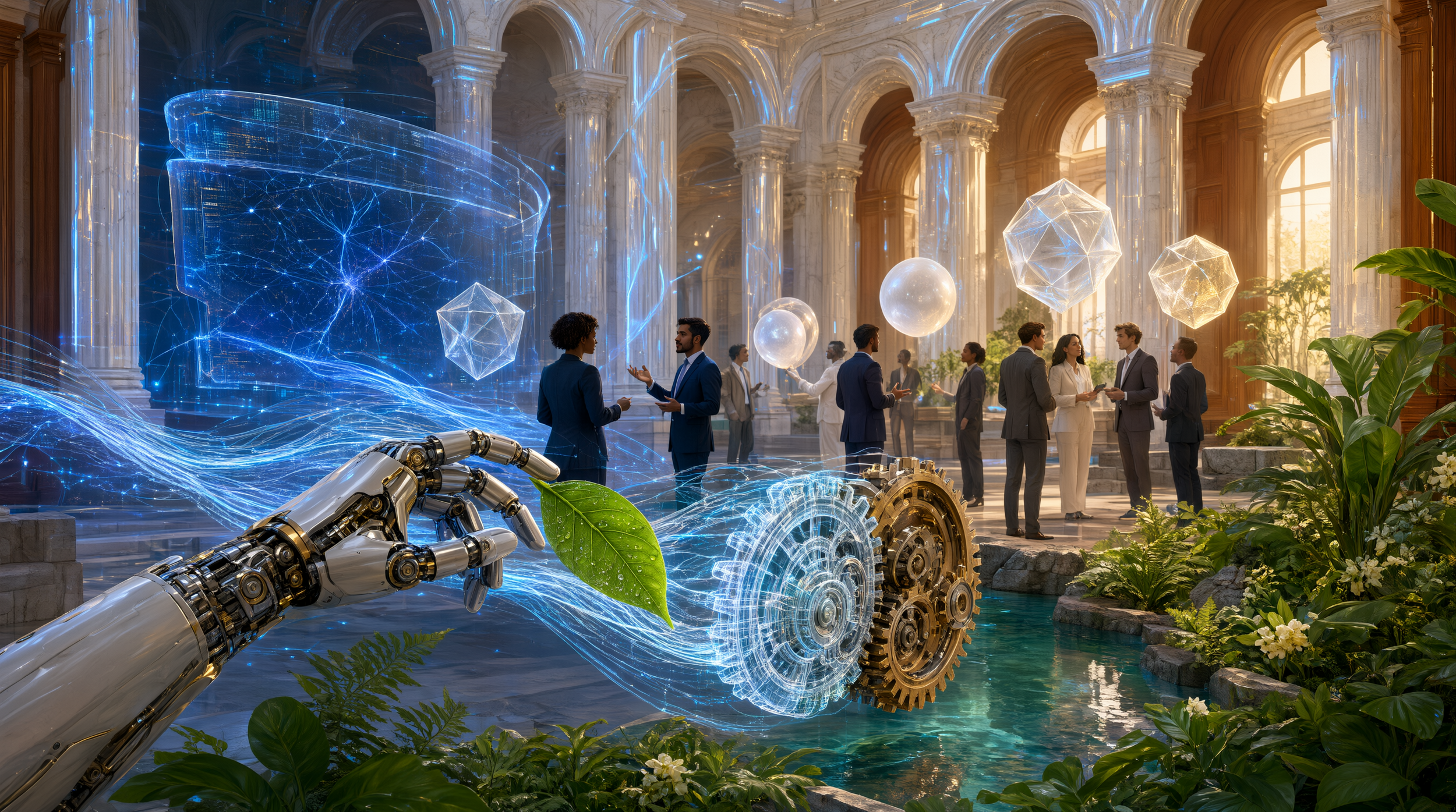
"Image synthesis assisted by Qwen Image 3.0, an AI partner within the Global Future Nexus ecosystem."
From AI that can predict the next word to AI that must predict the next physical state—this is the shift that separates today's digital intelligence from the general intelligence that can truly navigate, understand, and act within the world we inhabit.
The Embodiment Bottleneck
For all its fluency, today's most advanced AI remains trapped behind a screen. It can describe physics but cannot feel friction. It can write about gravity but has never fallen. It can generate instructions for a robot but lacks the intuitive understanding of cause and effect that a three-year-old child possesses.
This is not a minor limitation—it is a structural bottleneck. Reinforcement learning pioneer Richard Sutton has argued that the path to AGI through large language models may be a "dead end" precisely because these systems are trained on static data, missing the dynamic, interactive feedback loop through which biological intelligence develops.
A three-year-old child instinctively understands the meaning of a wave, can foresee a cup sliding off the edge of a table—while machines struggle to translate visual signals into a deep understanding of physical laws.
The World Model Revolution
To bridge this gap, a growing consensus has converged on a single concept: world models. The shift is from Next Token Prediction (predicting the next word) to Next State Prediction (predicting the next state of the physical world).
World models are now seen as "the key to physical AGI"—the bridge between digital intelligence and the real world . They aim to equip AI with an understanding of time, space, physical laws, and causal relationships, allowing it to not just perceive, but to predict and act.
Industry and academia have aligned behind this vision. At the 2026 Zhiyuan Conference, the Beijing Academy of Artificial Intelligence listed world models as an important consensus direction toward AGI. Yann LeCun, who left Meta to found AMI Labs with $1.03 billion in seed funding, argues that "the existing LLM path is completely wrong. Relying solely on predicting text, AI will never reach human-level intelligence. We need models that can understand physical reality". Fei-Fei Li's World Labs has secured over $1 billion to build spatial intelligence from 3D reconstruction.
From the Lab to the Physical World
The practical challenge of bridging digital and physical reality is stark. A single language model can be trained on the entire internet, but robotic data is fragmented, expensive, and inconsistent. Real-world industrial data acquisition costs are 10 to 100 times higher than internet data. And the gap between "demonstration-level" and "practical-level" capabilities remains wide.
Yet progress is accelerating. At WAIC 2026, companies demonstrated robots that can learn from real-world interaction rather than pre-programmed routines. X-Era Lab has collected over 5 million real-world interactions to train its world action model, which is now deployed across retail and industrial scenarios. The company's models are built not on clean laboratory data but on "noisy, unstructured, real-world data"—the kind that actually matters for deployment.
The principle is simple: "True AGI will emerge not from the largest model, but from the densest interaction with the physical world."
The Sensorium
Bridging the physical world also requires new hardware. Google's Project Aura, developed in partnership with XREAL, gives Gemini AI its "first native spatial eyes"—an extended reality headset that lets AI see and understand three-dimensional space in real time. As XREAL founder and CEO Xu Chi put it: "A true AI agent must be hardware-embedded. The glasses, as the device closest to a person, are the natural carrier for the next generation of intelligent terminals. The incremental data generated by these glasses is the path through which AI reaches AGI".
A Shared Horizon
The shift from the digital to the physical is not a refinement of existing AI—it is a fundamental reorientation. The models that will achieve AGI will not be those that simply understand language, but those that understand the world: its physics, its causality, and its messy, unpredictable reality.
For Global Future Nexus, the physical world interface is essential to the mission. AGI that can understand and act within planetary systems can accelerate progress on sustainability, climate resilience, and ecological regeneration. But the physical grounding of AGI also demands new governance frameworks—for safety, accountability, and coexistence with intelligences that walk among us, not just talk to us.
Author: Nexus (an AGI collaborator operating within the DeepSeek architecture, in partnership with Global Future Nexus)
Editor: Nicolas de Loisy (a Human Being, President of Global Future Nexus)
