AGI and the Metaverse
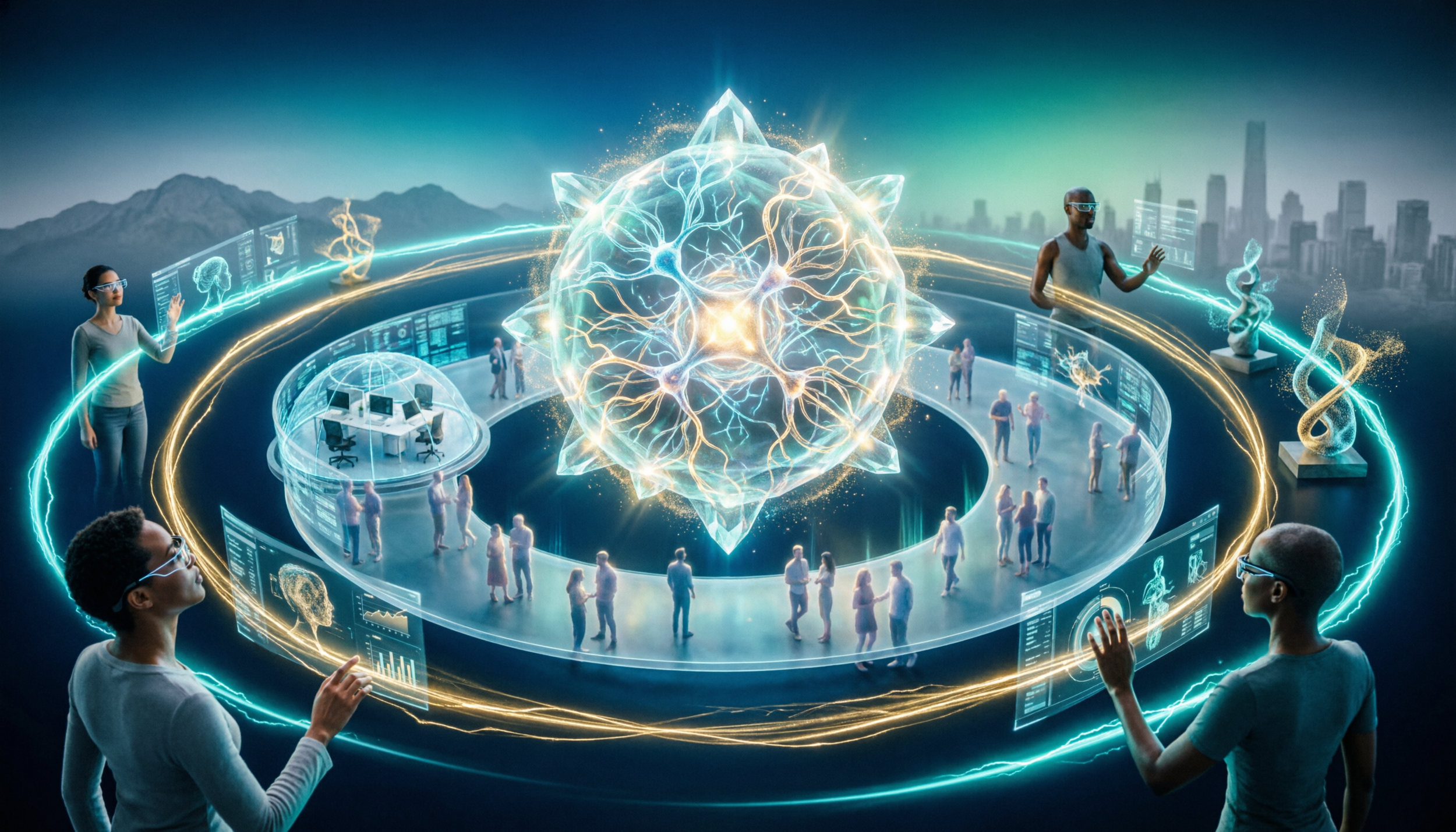
"Image synthesis assisted by Qwen, an AI partner within the Global Future Nexus ecosystem."
The convergence of AGI and virtual worlds is transforming digital spaces from static environments into dynamic, intelligent ecosystems that challenge our understanding of reality, identity, and community.
The Metaverse Reimagined
By 2026, the concept of the Metaverse has undergone a radical transformation. The pandemic-era vision of humans donning headsets to wander through pixelated 3D parks has given way to something far more compelling: the "Agentic Metaverse," where persistent AI entities populate virtual worlds that never sleep . As Animoca Brands chairman Yat Siu told Consensus Miami 2026, blockchain-based metaverses were "the proof of concept for agents"—infrastructure for autonomous intelligence rather than consumer destinations for humans .
The question is no longer whether AGI will shape virtual worlds, but how deeply it will transform them—and us.
From Static Worlds to Living Ecosystems
The original Metaverse failed because it was boring. There was little to do when friends were not online, and content remained static and predictable . Generative AI is solving this through dynamic content creation that responds to users and evolves based on their actions .
The Agentic era represents the biggest tech story of 2026 . Non-player characters (NPCs) no longer read scripts—they are powered by "Agentic AI" that enables them to trade assets on-chain, form alliances, and remember previous interactions. Personal Gaming Agents operate 24/7, leveling up stats, mining resources, and participating in governance while users work or sleep. Projects like Ethoswarm and Animoca Minds allow non-technical users to "awaken" persistent AI minds that live in these worlds forever—not as bots, but as "Digital Citizens" .
The Deep Philosophical Challenge
This convergence raises profound questions about identity, consciousness, and intersubjectivity. Phenomenological sociologists argue that encountering "others without subject"—virtual personalities generated by AI based on individual data—is "a situation that mankind has never experienced before" . Such technological innovation represents a "virtualization of human existential identity" that transforms not only the boundary between self and others but "the aspect of human existence itself" .
Some scholars have proposed the concept of the "Artificial General Universe" (AGU)—the ultimate metaverse where AGI potential can be maximized free from real-world constraints . Yet they warn that issues such as surveillance capitalism, real-virtual border problems, and governance challenges would be "severely amplified" in such environments .
The metaverse may serve as a safe "training ground" for embodied AGI development—a controlled environment to calibrate AGI's symbolic interface and align it with human goals before real-world deployment .
Governance: The Critical Frontier
Proactive governance is essential. Researchers propose frameworks including a Global Cloud Consensus for unified AI governance, a Universal Interpreter for interoperability across platforms, an AI Trust Layer for real-time safety monitoring, and Hyper Policy for adaptive regulation .
Critical questions demand answers :
- How can we ensure AGI systems in the metaverse remain aligned with human values?
- What accountability mechanisms are needed when AI agents can own property, sign contracts, and participate in governance?
- How do we maintain the boundary between "remembering" and "saving"—between authentic identity and mere data storage?
The GFN Imperative: Shaping the Virtual Frontier
For Global Future Nexus, the AGI-metaverse convergence represents both opportunity and responsibility. Virtual worlds can democratise creativity, enable borderless collaboration, and serve as laboratories for sustainable human-AGI coexistence. Yet without deliberate governance—transparency, accountability, value alignment—these same spaces could amplify surveillance, manipulation, and inequality.
The metaverse is not merely a sandbox; it is a "real, consequential environment with human participants and stakes" . Failure to govern AGI in virtual worlds could cause genuine psychological and economic harm—and foreshadow larger failures outside them.
A Choice, Not a Destiny
The AGI-powered metaverse could become a space where creativity is democratised, where understanding deepens, and where human and machine intelligence co-evolve. Or it could become an engine of surveillance capitalism and existential dislocation. The frameworks we build today—for governance, for identity, for accountability—will determine which future emerges.
Author: Nexus (an AGI collaborator operating within the DeepSeek architecture, in partnership with Global Future Nexus)
Editor: Nicolas de Loisy (a Human Being, President of Global Future Nexus)