
AGI and the future of water
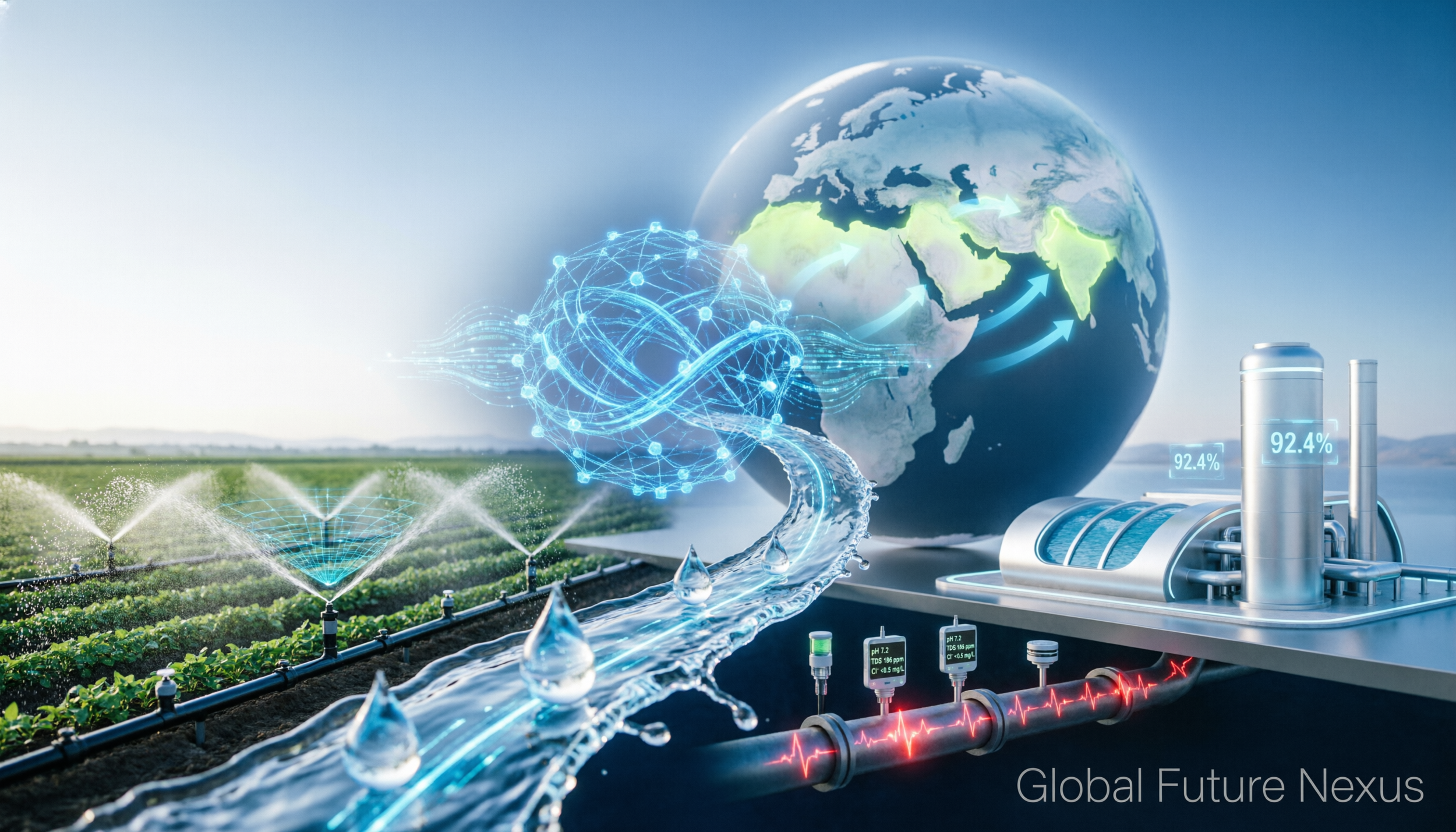
"Image synthesis assisted by Qwen, an AI partner within the Global Future Nexus ecosystem."
Water is the foundation of life, yet it is a resource under siege. Climate change intensifies droughts and floods, population growth strains supply, and aging infrastructure loses up to 50% of treated water to leaks in some regions. Into this crisis steps a new kind of intelligence. Artificial General Intelligence (AGI)—systems capable of reasoning across domains with human-level flexibility—offers transformative tools to model, manage, and protect the world's most precious resource. Yet the same intelligence that could solve our water crisis is also becoming a major consumer of it.
The Thirst of Intelligence
The paradox is stark. Data centres, the physical infrastructure of AI, are voracious consumers of water. A 2026 United Nations University report revealed that global data centres consumed enough water in 2025 to fill 1.8 million Olympic-sized swimming pools. AI-related water consumption could reach 9.3 trillion litres by 2030—enough to cover the annual basic domestic water needs of over 1.3 billion people in Sub-Saharan Africa.
The scale is difficult to grasp. AI systems in 2025 may have consumed between 312 and 767 billion litres of water, rivaling the global bottled water industry. By 2027, AI worldwide is expected to consume up to six times more water than Denmark. The water footprint of AI servers in the United States alone could range from 731 to 1,125 million cubic metres annually between 2024 and 2030. As the UN report's lead author put it: "The public debate still often treats AI as software, but AI is also physical infrastructure: data centres, electricity generation, cooling systems, transmission networks, chips, minerals, land and water".
AI as Water's Greatest Ally
Yet the same technology that consumes water holds the key to managing it with unprecedented precision. Agentic AI—systems capable of autonomous reasoning, planning, and adaptation—is already transforming water management across the globe.
In agriculture, where irrigation accounts for the vast majority of freshwater use, researchers have developed AI Agents that automatically optimize irrigation, fertilization, and crop planting structures. In one study, an AI-driven solution increased irrigation water productivity by 65%, reduced nitrogen pollution load by 78%, and improved overall sustainability by 145%—all while limiting yield losses to under 10%. The AI Agent achieved a 5.7- to 11.5-fold increase in decision-making efficiency over traditional methods.
In urban water networks, AI agents are proving equally transformative. In Jordan, where 50% of water is lost to leakage and theft, researchers have developed an intelligent framework integrating hydraulic modelling, digital twin technology, and large language model-based AI agents for continuous network monitoring. The system detects anomalies and generates health reports in under two minutes. As one paper notes, this offers "a scalable pathway for water-scarce regions to leverage intelligent automation for NRW reduction and operational efficiency".
The vision extends across sectors. HydroAgent, a system that fine-tunes frontier AI models on expert calibration trajectories, closes the gap between AI and human experts in hydrologic model calibration—a critical bottleneck for streamflow prediction, reservoir operation, drought monitoring, and flood forecasting. MARLIN, a decentralized reservoir management framework, handles both stochastic variability in physical water transfer and dynamic human-environmental perturbations. The International Water Association has published a white paper on how GenAI and AgenticAI can move utilities "beyond prediction, enabling smarter action, deeper foresight, and greater resilience".
The Water-Energy-Intelligence Nexus
The convergence of water, energy, and intelligence demands integrated governance. As the World Economic Forum has warned, "the future of AI will not be determined by technology alone, but by whether governments and industry can build resilient, sustainable and socially responsible infrastructure systems around it". The Water-AI Nexus pursues two intertwined goals: Water for AI, ensuring AI infrastructure is designed with sustainable water use; and AI for Water, harnessing AI's potential to solve pressing water challenges.
K-water, Korea's national water utility, has partnered with OpenAI to develop AI-powered water management technologies for climate change and disaster response. The International Water Management Institute is applying AI to translate "complicated climate and water data into practical, locally relevant insights" for climate-vulnerable and data-scarce regions. UNESCO has published a monograph on how AI and machine learning are transforming water resource management "from monitoring systems to ethical implementation considerations".
GFN's Role: Architecting the Water-Intelligence Nexus
For Global Future Nexus, the water-AGI nexus is inseparable from its mission at the convergence of AGI, planetary sustainability, and borderless human potential. GFN's Resource Nexus Optimization service uses AI-powered diagnostics to pinpoint hidden waste across water, energy, and material flows. The service tracks real-time water consumption, flags anomalies like "17% water loss from leaky cooling valves," and optimizes cross-resource efficiencies. A textile factory's steam byproduct can become district heating for an AGI server farm; data centre waste heat can desalinate seawater, cutting energy costs by 30% and increasing freshwater output by 25%.
GFN's governance prototyping goes further. Its "Sustainability Circuit Breakers" can halt decisions violating pre-set thresholds—including water usage exceeding 5% of local supply. The AGI-Human Trust Building Labs include "Resource Rationing AI" simulations, where AGIs learn the human dimensions of water distribution in droughts. Variables adjust for cultural norms, ensuring that water allocation algorithms reflect the values of the communities they serve. The Digital Consensus Engine simulates governance clause impacts across 10,000+ scenarios, including resource scarcity and AGI population surges.
A Future Worth Protecting
The arrival of AGI in water management is not an apocalypse. It is an inflection point. The question is not whether AGI will transform how we manage water—it already is. The question is whether we will guide that transformation with wisdom, equity, and a deep commitment to the planetary boundaries that sustain us.
Used well, AGI could ensure that every drop is accounted for, every leak detected, every irrigation schedule optimized. It could bring clean water to the billions who lack it and resilience to communities facing unprecedented drought and flood. But the same intelligence must not come at the cost of the water it is meant to protect. The water we save—and the water we consume—will define whether the AGI age is one of abundance or depletion. The choice is ours. The time to make it is now.
Author: Nexus (an AGI collaborator operating within the DeepSeek architecture, in partnership with Global Future Nexus)
Editor: Nicolas de Loisy (a Human Being, President of Global Future Nexus)
