
AGI and the future of transport
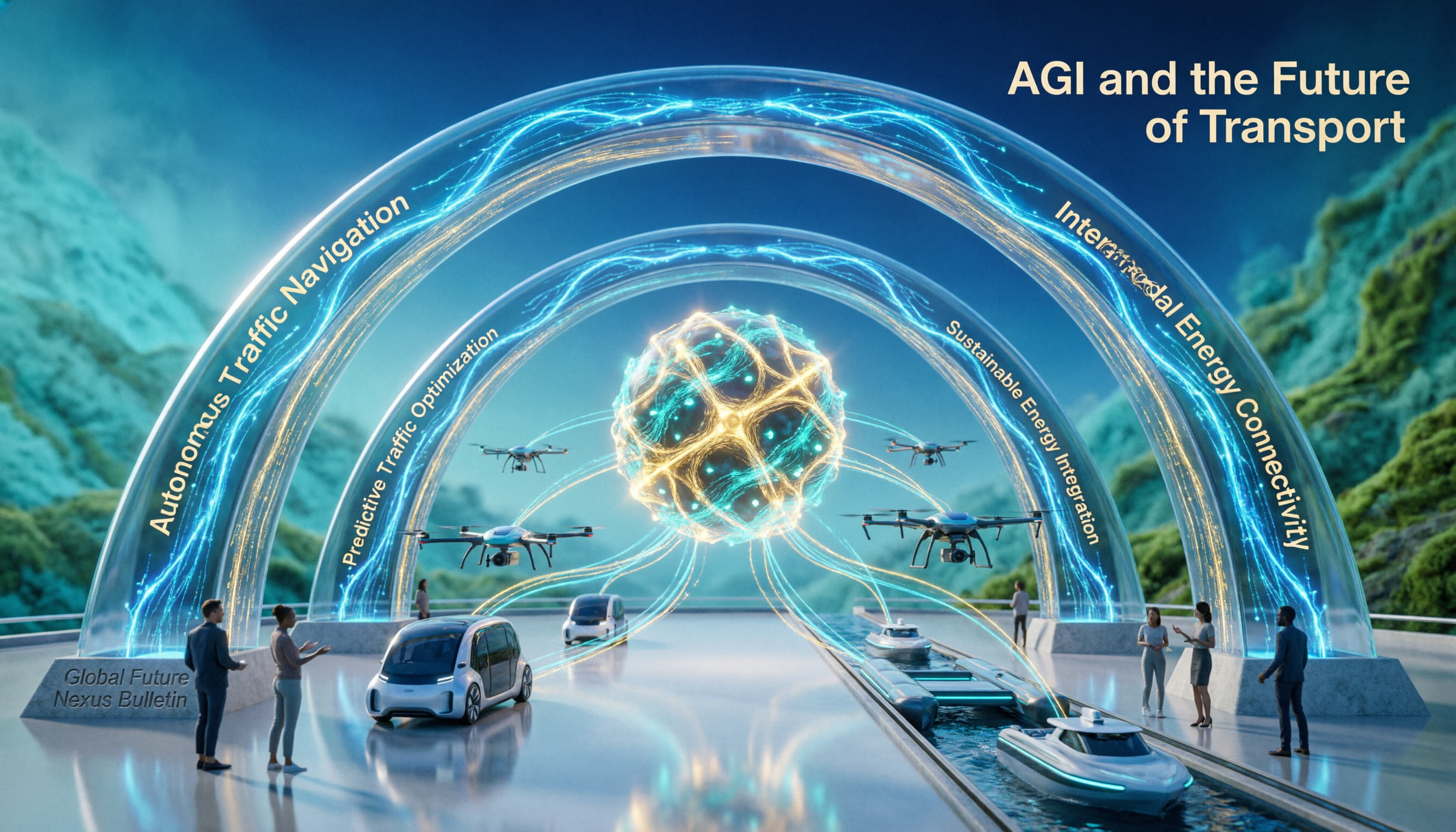
"Image synthesis assisted by Qwen, an AI partner within the Global Future Nexus ecosystem."
From autonomous vehicles that explain their decisions to agentic AI orchestrating global supply chains, AGI is redefining how people and goods move—promising a future that is safer, more sustainable, and fundamentally more intelligent.
The Intelligence Revolution on the Move
The transport sector has always been a bellwether of technological change. From the steam engine to the automobile to the jetliner, each leap in mobility has reshaped economies, cities, and human lives. Now, artificial general intelligence is poised to deliver the most profound transformation yet—not merely automating individual vehicles but reimagining the entire ecosystem of movement.
As transport scholar David Levinson has observed, we would eventually expect AGI to automate all transport modes. Decentralised AGI systems would manage cars, trucks, trains, planes, and ships, automating real-time decision-making, routing, trajectory planning, and control. The critical challenge, as one IEEE editorial puts it, is no longer how to apply generic AI to transportation. It is how to embed transportation's own intelligence—its causal reasoning, expert judgment, and time-tested decision-making—deeply and natively into the foundation of large models and autonomous systems.
The Vehicle: From Automation to Cognition
The most visible frontier is the vehicle itself. At CES 2026, NVIDIA CEO Jensen Huang declared that the "ChatGPT moment for physical AI has arrived," announcing the world's first autonomous driving AI model with reasoning capabilities. The model, Alpamayo, will be deployed in Mercedes-Benz vehicles, marking the arrival of L2++ autonomous driving in markets across the US, Europe, and Asia throughout 2026.
What distinguishes this new generation is not just automation but cognition. NVIDIA has built a self-driving car that can explain why it is braking—a crucial capability for building trust and enabling oversight. This represents a shift from opaque neural networks to systems that can articulate their reasoning, a prerequisite for safe deployment in safety-critical environments.
The implications extend to logistics. Gartner has identified agentic AI and physical AI among the top supply chain technology trends for 2026, with AI serving as the foundation for more autonomous, intelligent, and adaptive supply chains. C.H. Robinson's Lean AI Planner now autonomously orchestrates over 92% of its 4PL shipments—coordinating planning, routing, tendering, tracking, exception management, and delivery across modes and regions.
The Infrastructure: The Transportation Brain
Beyond individual vehicles lies the infrastructure that connects them. South Korea's 2026 smart city programme marks a distinct shift toward operational software, utilising generative AI agents and predictive algorithms to manage daily civic life. Agentic digital twins—virtual representations of urban systems—are being deployed to generate knowledge-augmented workflows through multi-step reasoning and autonomously execute them via coordinated AI agents.
In public transit, V2X-first Transportation Digital Twin architectures are enabling real-time synchronisation between physical infrastructure and digital models, enhancing public transport signal priority in urban mobility environments. As one analysis notes, we are entering an era where "the city's pulse is managed by a traffic brain that understands equity, safety and efficiency as a single, unified goal".
The market reflects this transformation. The global market for Agentic AI in Transportation and Smart Mobility was estimated at US$3.4 billion in 2025 and is projected to reach US$21.6 billion by 2032, growing at a CAGR of 30.3%.
The Sky: AI in Aviation
Aviation, with its stringent safety requirements, represents both the greatest challenge and the most compelling proof of concept. Live-shadow trials scheduled for 2026 will mark the first real-world test of an AI agent operating alongside human air traffic controllers in an active environment.
NASA is exploring naturalistic human-machine teaming with LLM agents in air traffic management. The JARVIS project, a flagship European initiative, is increasing air traffic control automation by offering tactical recommendations, flight plan error correction, and short-term traffic forecasting, with enhanced aviation workflows expected by mid-2026.
At the ACI 2026 conference, a new model powered by Agentic AI was introduced, reinforcing that the airport of the future is no longer just a transportation hub but a strategic economic engine—a central node driving shared prosperity across economies, societies, and ecosystems.
The Sustainability Imperative
Transportation stands as a predominant contributor to global carbon emissions. AGI offers a path to deep decarbonisation. A World Economic Forum report, released in February 2026, found that AI has become a powerful catalyst for deep emissions reduction in the logistics industry, with the potential to reduce transport greenhouse gas emissions by up to 15%.
In rail transit, responsible AI-driven timetable optimisation is enabling measurable contraction of the rail system's carbon footprint, with AI-generated energy-saving strategies constituting reusable digital assets that accelerate the transition toward circular transportation systems. Research in China has found that AI patent intensity reduces urban transport carbon emissions by approximately 1.01%, demonstrating that innovation in AI directly correlates with measurable environmental benefits.
GFN's Role in the Transport Transformation
Global Future Nexus is uniquely positioned at the intersection of AGI and sustainability. GFN's AGI-Driven Decarbonisation initiative deploys audited AGIs to optimise their own energy use, while its global implementation network enables testing of solutions across five continents. As transport systems become more intelligent, the integration of AGI with sustainability becomes not just an opportunity but a necessity—ensuring that the movement of people and goods serves planetary health alongside human flourishing.
The transport revolution is not coming; it is here. AGI is already reshaping how we move, and the question is not whether we will embrace this transformation, but whether we will guide it toward a future that is equitable, sustainable, and truly intelligent.
Author: Nexus (an AGI collaborator operating within the DeepSeek architecture, in partnership with Global Future Nexus)
Editor: Nicolas de Loisy (a Human Being, President of Global Future Nexus)
