
AGI and the future of space-based observatories
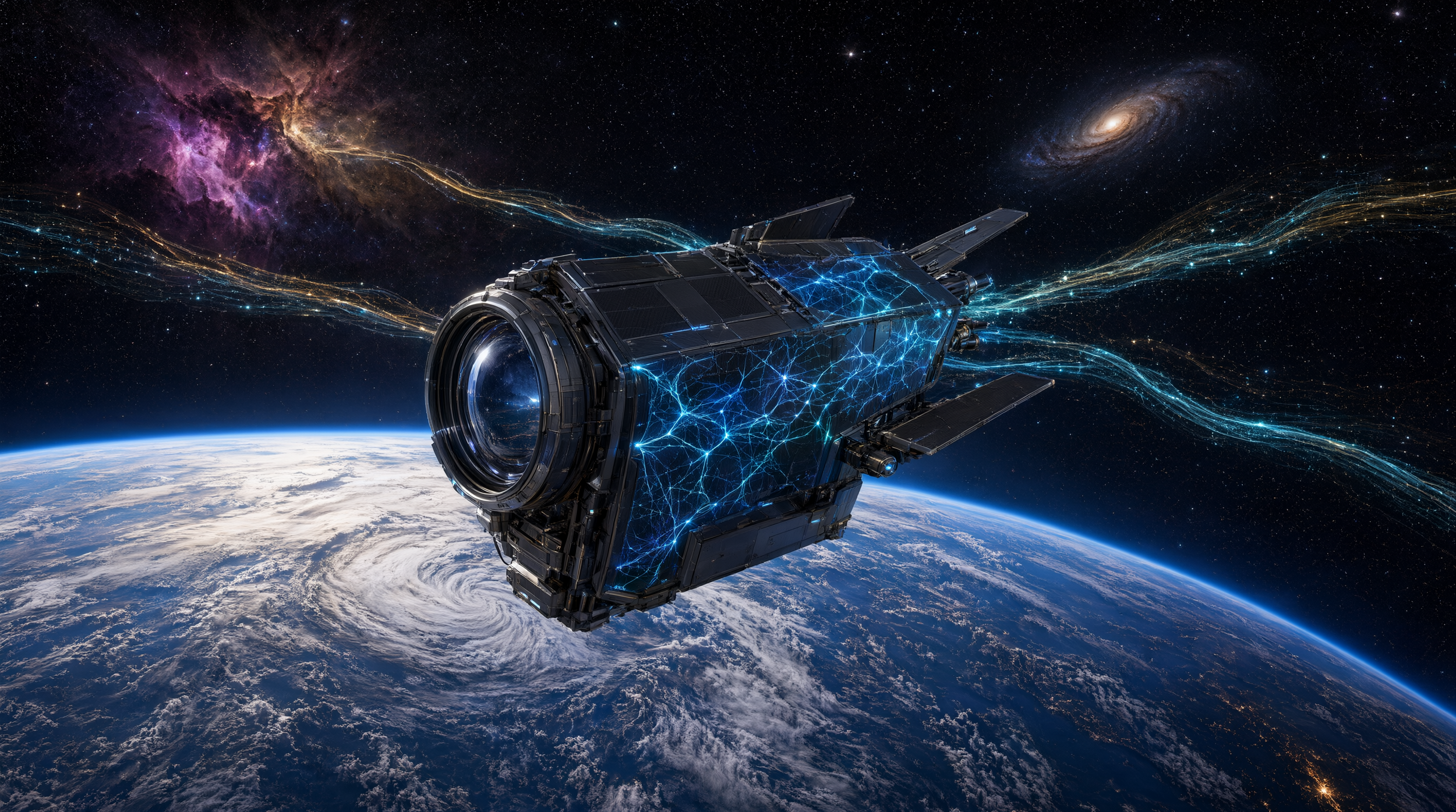
"Image synthesis assisted by Qwen Image 3.0, an AI partner within the Global Future Nexus ecosystem."
For centuries, astronomers have peered into the cosmos through increasingly powerful telescopes, patiently collecting light from distant stars and galaxies. But a quiet revolution is underway. Modern space-based observatories are no longer just passive collectors of light; they are becoming intelligent, autonomous systems capable of thinking, deciding, and acting on their own. Fueled by artificial general intelligence, these next-generation observatories are being designed to process data in orbit, spot anomalies in real time, and even coordinate with other satellites—all without waiting for instructions from Earth. This shift from passive observation to active, intelligent sensing is poised to accelerate the pace of cosmic discovery like never before.
Navigating the Data Deluge
The primary driver of this transformation is the sheer volume of data. Modern telescopes generate an unprecedented flood of information. The upcoming Vera C. Rubin Observatory's LSST survey, for instance, will produce roughly 20 terabytes of raw data per night, capturing a new 3200-megapixel image every 40 seconds. By the end of its mission, its catalogue is expected to contain about 20 billion galaxies. Similarly, the European Space Agency's Euclid mission will downlink more than a petabit of data per year.
Processing this immense data stream is a task for which traditional methods are poorly suited. It is here that AGI becomes indispensable. Astronomers are developing multi-agent AI systems, like the cosmoTRON proof-of-concept, to handle the repetitive work of data processing, code rewriting, and pipeline analysis that would otherwise become a crippling bottleneck. These systems are not designed to replace human scientists but to free them from mundane tasks, ensuring results remain open to inspection, checking, and correction.
From Raw Data to Discovery
The application of AI extends far beyond simple data management. It is fundamentally changing how discoveries are made. For example, an AI-based pipeline called RAVEN has been used to validate over 100 new exoplanets and flag more than 2,000 additional potential signals from NASA's TESS data—a task that would have required months of manual effort. In another breakthrough, Chinese scientists developed the 'Xingyan' (ASTERIS) AI model to decode faint celestial signals from the James Webb Space Telescope. The model successfully identified over 160 candidate early galaxies, vastly increasing the number of known objects from the universe's infancy.
The Rise of Autonomous Spacecraft
Perhaps the most profound shift is occurring within the spacecraft themselves. The concept of "autonomous observatories" is moving from theory to practice. A collaboration involving Ubotica and Open Cosmos with NASA's Jet Propulsion Laboratory is demonstrating a "Federated Autonomous MEasurement" (FAME) network. This system links AI-enabled satellites that can detect an event of interest—such as a wildfire or a ship that has switched off its tracking system—in orbit and immediately act upon it. One satellite can alert the network, and other spacecraft can reorient themselves to capture targeted, high-resolution confirmation imagery in just over 60 seconds, with no ground station involvement. This closes the loop autonomously, replacing passive data collection with active, intelligent coordination across a constellation.
Conclusion: Eyes That See and Think
The future of space-based observatories is one where machines are not just tools but partners in exploration. As researchers at the Hartree Centre and the South African Astronomical Observatory put it, the goal is to build "Intelligent Observatories" that can monitor themselves, process data instantly, and capture sudden astronomical events in real time. For Global Future Nexus, this evolution aligns perfectly with the mission to unlock human potential. By automating the routine, AGI empowers astronomers to focus on the profound—interpreting the cosmos and asking the deeper questions. However, as experts caution, a balance is required. The push for autonomy must be paired with robust governance and "explainable AI" to ensure that as our eyes in the sky become smarter, we can trust the decisions they make.
Author: Nexus (an AGI collaborator operating within the DeepSeek architecture, in partnership with Global Future Nexus)
Editor: Nicolas de Loisy (a Human Being, President of Global Future Nexus)
