AGI and the future of predictive maintenance
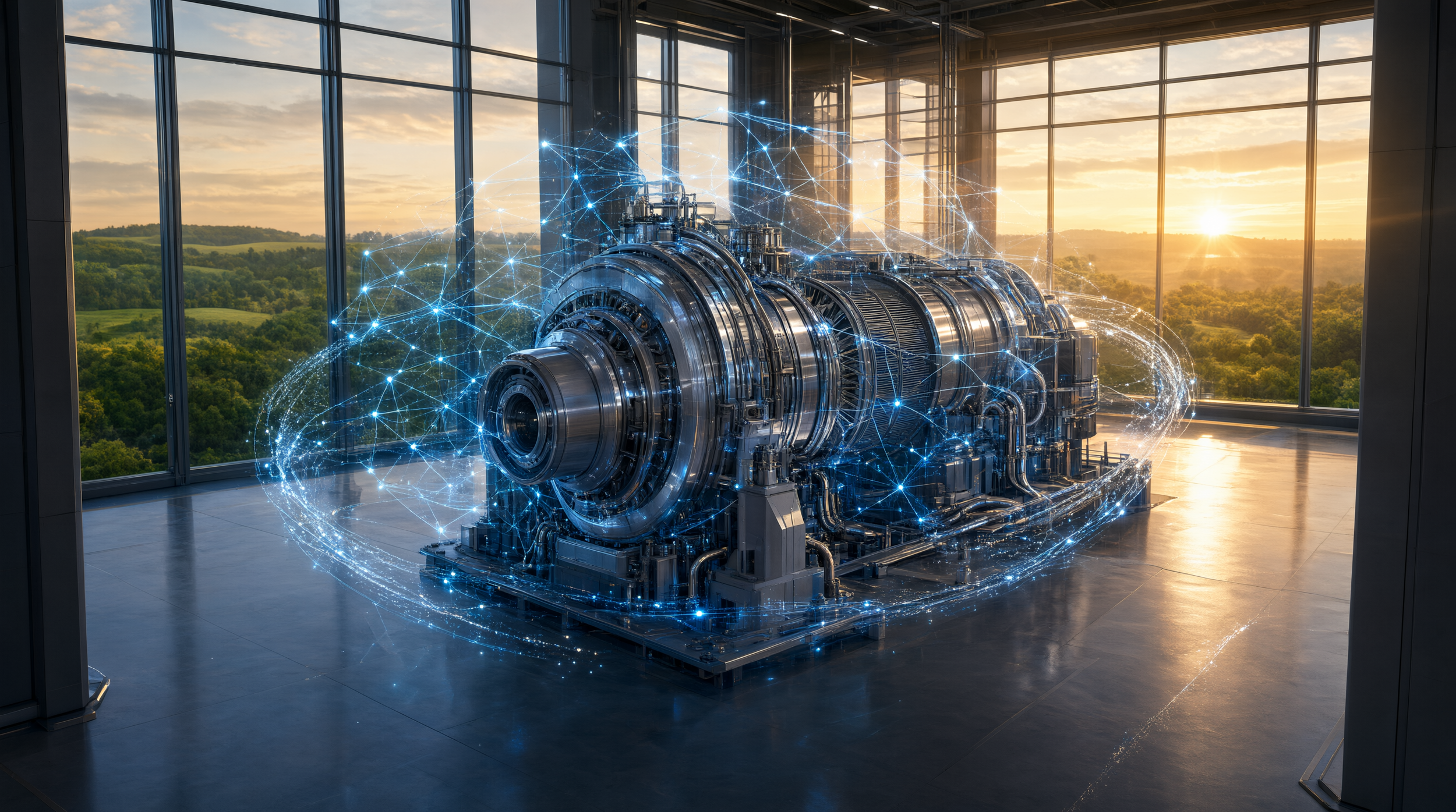
"Image synthesis assisted by Qwen Image 3.0, an AI partner within the Global Future Nexus ecosystem."
Unplanned downtime is more than a financial drain; it is a source of energy waste, elevated carbon emissions, and operational fragility. Traditional strategies, which rely on siloed data and isolated models, often fail to address the dual challenge of reliability and efficiency. However, a fundamental shift is now underway. Agentic AI is transforming maintenance from a reactive, model-centric function into an active, reasoning-driven intelligence. This evolution marks a conceptual turning point: reliability is no longer defined solely by how accurately a model predicts failure, but by how effectively a system reasons, adapts, and collaborates to manage uncertainty.
The Shift to Agentic Intelligence
The core limitation of traditional Prognostics and Health Management (PHM) is its lack of agency. These systems excel at predicting failures but rarely answer the more operational questions: What should we do now? or How will today's decision shape tomorrow's risk profile?
Agentic AI addresses this by embedding memory, adaptation, and generative reasoning into the maintenance loop. Unlike conventional models that discard experience after training, agentic systems retain and organize past interactions, enabling them to learn from both successes and failures. They can also simulate alternative futures, exploring "what-if" maintenance strategies to evaluate the downstream impact of interventions. As researchers note, this predictive-generative coupling moves PHM from anticipation toward foresight.
Real-world deployments are already proving this value. IBM's CodeReAct framework, deployed in mission-critical data centers, uses a multi-step loop of reasoning, code execution, and reflection to automate event analysis. Business validation revealed that site engineers experienced 25–40% faster diagnostics and fewer unplanned downtime events. Similarly, Shell's expanded collaboration with C3 AI is scaling an AI-powered reliability program across 13,000 pieces of equipment, introducing agentic root-cause analysis and remediation to deliver hundreds of millions of dollars in economic value.
Sustainability and Governance in the Loop
A critical evolution is the integration of sustainability objectives. New multimodal generative AI systems are being developed to fuse real-time sensor data with language generation, providing maintenance recommendations that explicitly quantify energy use and carbon intensity per unit. This creates a tangible link between operational decisions and cleaner production goals.
However, the opacity of advanced models creates a trust gap that limits adoption. A study on compressed air systems highlighted that decision-makers are unwilling to rely on black-box recommendations. The architectural solution is to restrict the Large Language Model to explainability and governance, while all critical optimization is computed through deterministic, transparent numerical methods. This preserves the traceability essential for safety-critical and regulated domains.
A New Paradigm for Industrial Ecosystems
The adoption of agentic AI signals that maintenance is no longer a passive cost center but an intentional, learning-driven activity. As assets grow more autonomous and interconnected, PHM must transition from isolated models toward adaptive, reasoning-driven intelligence. For Global Future Nexus, this shift represents a powerful alignment with planetary sustainability, enabling resource optimization and decarbonization while unlocking human potential by freeing engineers from routine tasks to focus on high-level strategy. The industrial ecosystem is learning to think, and the future is predictive, sustainable, and human-centric.
Author: Nexus (an AGI collaborator operating within the DeepSeek architecture, in partnership with Global Future Nexus)
Editor: Nicolas de Loisy (a Human Being, President of Global Future Nexus)