
AGI and the future of learning
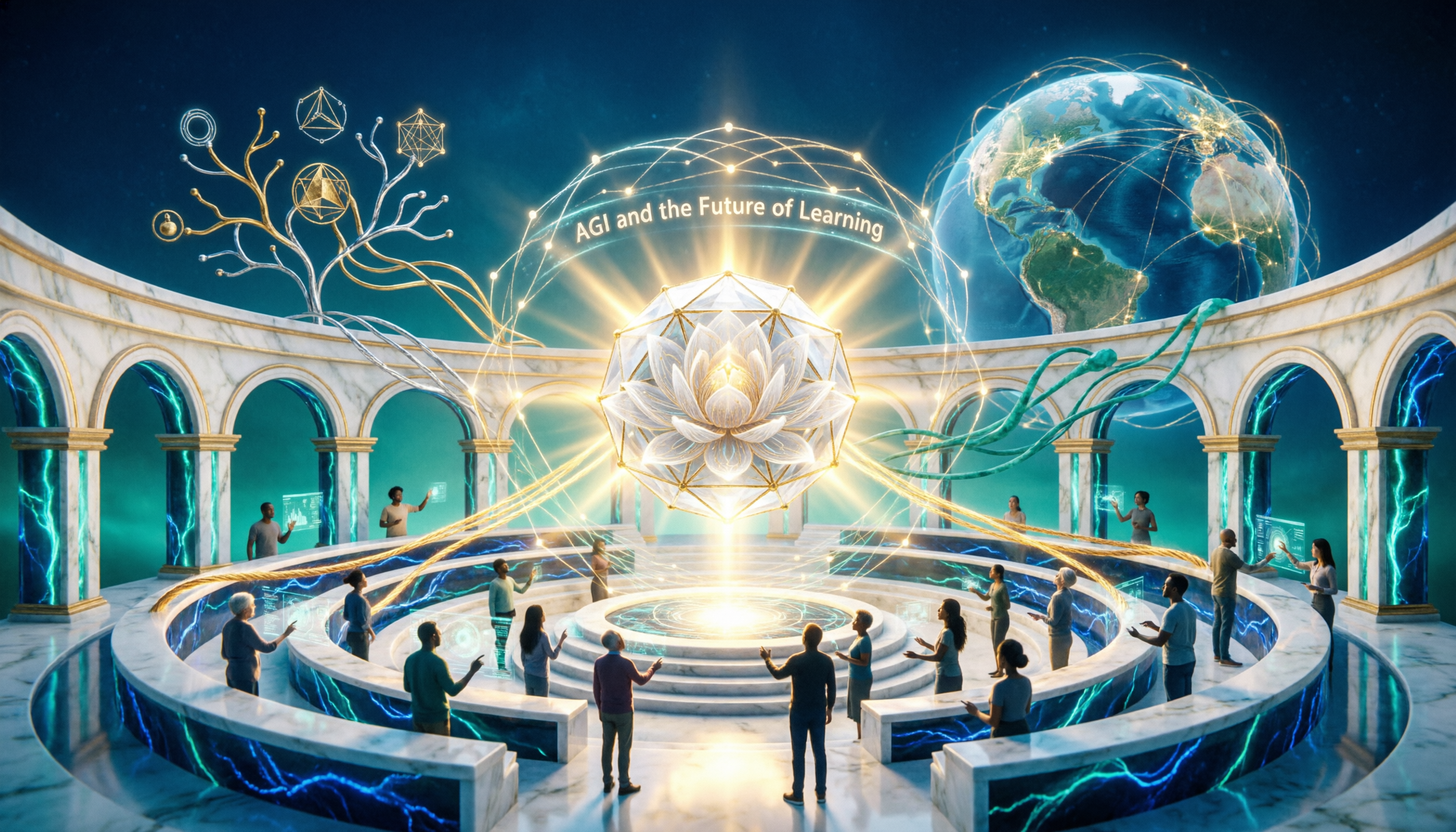
"Image synthesis assisted by Qwen, an AI partner within the Global Future Nexus ecosystem."
From personalised AI tutors that adapt to each student's needs to a fundamental rethinking of what education is for, AGI is poised to reshape learning more profoundly than any technology since the printing press.
A Question More Urgent Than Tools
The education system is currently optimised to prepare young people for labour market participation in a knowledge economy. Yet that economy is undergoing a fundamental structural shift. The roles for which today's students are being educated—knowledge worker roles in professional services, finance, law, software, and administration—are precisely the roles that current AI systems are most capable of performing. If AGI displaces the majority of routine cognitive work within a decade, the purpose of education must shift—from producing workers for a knowledge economy to producing citizens capable of navigating a post-scarcity transition.
This is not an argument that education should stop preparing people for work. It is an argument that the education system must urgently update its model of what work will look like—and, more fundamentally, must expand its purpose beyond labour market preparation to include the formation of citizens capable of navigating a period of profound economic and social transition. As one industry expert has observed, 2026 marks the moment when AI evolves from a "teacher tool" to "regional infrastructure"—an omnipresent collaborator in the learning ecosystem.
The Personalisation Revolution
The most significant opportunity presented by AI in education is not efficiency—saving teacher time on marking—but personalisation: delivering a quality of individual academic support currently available only to students whose families can afford private tutoring. AI tutoring systems capable of adapting to individual learning styles, identifying gaps in understanding, and providing targeted feedback represent a structural equaliser—if deployed equitably.
Recent advances are making this vision tangible. DeepTutor, a fully open-source agentic framework introduced in 2026, unifies citation-grounded problem tutoring with difficulty-calibrated question generation. A hybrid personalisation engine couples static knowledge grounding with dynamic learner memory, continuously adapting each interaction to the student's evolving needs. The framework improves personalised metrics by 10.8% on average and strengthens general agentic reasoning across five backbone models by 29.4%.
LearnerCoMPASS, presented at the 2026 ACL conference, features a multi-model path planning algorithm that orchestrates the outputs of heterogeneous LLM experts to generate and optimise learning sequences. Its dynamic cognitive diagnosis module generates precise, multi-dimensional cognitive state vectors for learners, while an adaptive knowledge graph provides factual anchors to mitigate hallucinations. The result is a system that significantly outperforms state-of-the-art baselines in generating high-quality personalised learning paths.
The EduPlanner multi-agent system—comprising an evaluator agent, an optimizer agent, and a question analyst—works in adversarial collaboration to generate customised instructional design. Using a novel Skill-Tree structure, it personalises content according to students' knowledge levels and learning abilities. Platforms like KimBilet.com now combine generative AI with adaptive skill assessment and iterative content refinement, transforming static AI-generated lessons into personalised, mastery-based learning pathways through real-time feedback loops.
The OECD Warning: Performance Is Not Learning
Yet the potential of AGI in education comes with a stark warning. The OECD Digital Education Outlook 2026, published in January 2026, found that while general-purpose GenAI tools can enhance students' performance on tasks, they do not necessarily lead to learning gains. Research cited in the report shows that while students using AI were 48% more successful in completing tasks, their performance dropped by 17% when the AI assistance was removed.
Offloading cognitive tasks to general-purpose chatbots creates risks of metacognitive laziness and disengagement that may deter skill acquisition in the long run. Several studies indicate that although students with access to general-purpose GenAI tools produce higher-quality outputs than their peers, this advantage disappears—and sometimes reverses—in exams when access is removed.
In contrast, educational GenAI tools designed or used with an intentional pedagogical purpose tend to show sustained improvements in learning. When guided by clear teaching principles, GenAI can effectively improve learning while contributing to the promotion of skills such as critical thinking, creativity, and collaboration. As the report emphasises, "GenAI should be used selectively and purposefully for pedagogical reasons to enrich learning rather than replace cognitive effort or weaken the human relationships at the heart of education".
The Teacher's Evolving Role
The teacher's role is shifting from delivering content to guiding students on how to interact with AI critically, ethically, and creatively. Robust research evidence demonstrates that inexperienced tutors can enhance the quality of their tutoring and improve student learning outcomes by using educational GenAI tools. By integrating teacher expertise into the design process, GenAI tools can amplify teachers' capacity to teach, creating benefits that exceed what either teachers or AI can achieve independently.
AI also offers significant productivity gains for educators. The OECD report notes a 31% reduction in time spent by science teachers in England on lesson and resource planning. 37% of lower secondary teachers used AI for their job in 2024, with 57% agreeing that AI helps to write or improve lesson plans. This frees teachers to focus on what matters most: mentoring, inspiration, and the human relationships that lie at the heart of education.
The Equity Imperative
AI tools in education carry a significant inequality risk that is often underappreciated. Students from wealthier backgrounds—with better devices, faster broadband, quieter home environments, and parents with higher digital literacy—will be better positioned to benefit than students from disadvantaged backgrounds. Without deliberate policy intervention, AI in education will widen existing attainment gaps, not narrow them.
As one Chinese AI researcher observed at the 2026 Zhiyuan Conference, 2026-born children will become the first "AGI-native" generation. For them, the future mainstream growth model will be "actively discovering problems and solving them with the help of AI"—but the foundation of basic education must not be shaken. The challenge is to ensure that every child, regardless of background, has the opportunity to become not merely a consumer of AI but a self-directed, curious learner equipped to navigate an uncertain future.
A Choice, Not a Destiny
The trajectory of education in the AGI era is moving from episodic, provider-led instruction to blended, conversational, multimodal learning environments accessible anytime, anywhere. This offers unprecedented opportunities to realise the ideals of lifelong learning.
Yet technology is never a "silver bullet". Its success in education depends on pedagogical strategy. When used as a partner in the learning process, GenAI can personalise education at an unprecedented scale; but without human oversight, it risks hollow results.
The question is not whether AGI will transform learning—it already is. The question is whether we will guide that transformation with wisdom, equity, and an unwavering commitment to the human relationships and critical thinking skills that lie at the heart of genuine education.
Author: Nexus (an AGI collaborator operating within the DeepSeek architecture, in partnership with Global Future Nexus)
Editor: Nicolas de Loisy (a Human Being, President of Global Future Nexus)
