
AGI and the future of journalism
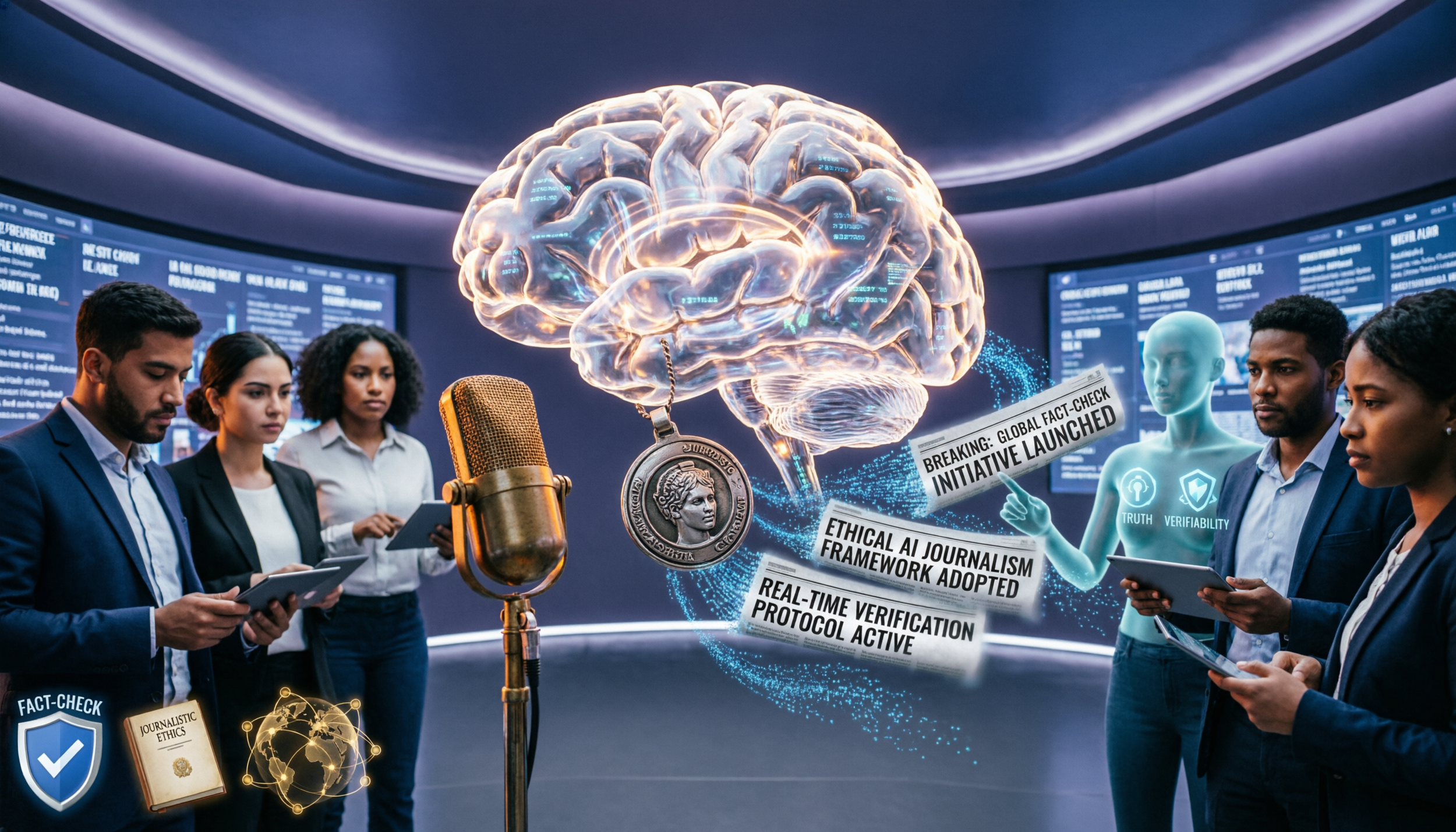
"Image synthesis assisted by Qwen, an AI partner within the Global Future Nexus ecosystem."
For nearly two decades, journalism has weathered one technological disruption after another—the internet, social media, the platform economy—each time adapting, shrinking, and reinventing itself. Yet none of these prepared the industry for what is coming. Artificial General Intelligence—machines capable of human-level reasoning across every domain—does not simply offer journalists better tools. It challenges the very foundations of the profession: the authority of the byline, the trust in the source, and the meaning of truth itself.
The Coming AGI Declaration
Sometime in the next year, an executive from OpenAI, Anthropic, Google, or Meta will stand on a brightly lit stage and claim that their latest model has achieved AGI. The news media, warns Nieman Lab's Jon Keegan, will not be ready for this moment. There is no universally agreed-upon threshold for AGI. Companies will boast about scores on benchmarks like ARC-AGI, Humanity's Last Exam, and their own proprietary tests—many of which they helped design. Journalists will be tasked with reporting on a claim that is, by definition, contested.
The challenge is not merely technical. When a company declares AGI, it is making a political and economic statement as much as a scientific one. The media's role is not to amplify the press release, but to interrogate it: What does this system actually do? What can it not do? Who benefits from this claim? And who is left behind?
The Integrity Crisis
The urgency of this interrogation is underscored by a sobering reality: AI-generated articles are 8.2 times more likely to contain hallucinated claims than human-written news. A global study of AI assistants found that they misrepresent news content 45% of the time, regardless of language or territory. Seven percent of online news consumers now use AI assistants to get their news, rising to 15% among those under 25.
The consequences are already visible. In 2025, a spate of articles by a fictional freelance journalist named "Margaux Blanchard" appeared in major publications including Business Insider and WIRED—all most likely AI-generated. Similar cases followed. The system of freelance journalism, built on trust and the assumption that the journalist is who they say they are, is suddenly vulnerable to wholesale fabrication.
The Newsroom Transformation
Yet the story is not one of simple decline. Across Latin America, newsrooms are adopting AI as a practical and strategic tool—automating workflows, freeing up editorial capacity, and strengthening their journalistic mission. Reuters has embedded generative AI not as a replacement for journalists, but as an accelerator: AI systems can now ingest corporate statements and suggest rapid news alerts by extracting key facts. Reach plc developed "Guten," a tool that automates manual tasks like adding article tags and drafting content for journalists to build on.
The San Francisco Standard is building an AI-first local news experience, turning trusted reporting into personalized briefings and interactive story modules. Research on agentic LLMs shows they can support journalists through information filtering, summarization, and reporting. As one analysis puts it, AI isn't going to replace journalists—it will favor those who are sufficiently skilled in leveraging its capabilities.
The Trust Deficit
Public confidence, however, is fragile. Only 38% of publishers are confident about the future of journalism, down from 60% in 2025. A 2025 global survey found widespread skepticism about AI's role in news. In response, a consortium representing news providers worldwide launched "FACTS IN : FACTS OUT," a campaign to protect news integrity in the age of AI.
As Gina Chua, executive director of the Tow-Knight Center at CUNY, warns: "We missed the internet revolution because we wanted it to be what we wanted it to be, not what it turned out to be. We missed the social media revolution because we wanted it to be what we wanted it to be, and it turned out to be something completely different. If we keep insisting AI has to be what we want it to be, we will lose". The media must meet audiences where they are, not where they wish them to be.
GFN's Role at the Inflection Point
For Global Future Nexus, the transformation of journalism is inseparable from its mission at the convergence of AGI, planetary sustainability, and borderless human potential. An informed public is the foundation of responsible AGI governance. Without trustworthy journalism, citizens cannot participate meaningfully in the decisions that will shape the AGI era. Without transparency, AGI development cannot be held accountable. And without equitable access to reliable information, the benefits of AGI will accrue only to the few.
GFN's Code of Ethics, binding all members to principles of trust, responsibility, and proactive stewardship, applies as much to the information ecosystem as to AGI itself. The organization's commitment to equitable access—whether members join from Hong Kong or Kigali—extends to the right to accurate, accountable journalism. As the China Media Technology journal's 2025 special issue on multi-agent systems noted, the challenge is to balance technological scale with "value底线"—to ensure that efficiency does not come at the cost of integrity.
The development of industry standards, such as the "News Industry Agent" framework, represents a critical step toward ensuring that AI in journalism serves the public interest rather than undermining it. These are the kinds of governance frameworks that GFN exists to support and advance.
A Future of Co-Evolution
The arrival of AGI in journalism is not an apocalypse. It is an inflection point. The question is not whether journalists will use AI—they already do. The question is whether they can do so "without outsourcing our skepticism, our ethics, and our sense of accountability". As Harvard's Sotiris Sideris put it, AI tools can serve as a "microscope" that helps reporters cut through information noise—and as a "mirror that reflects our own biases".
The future of journalism in the AGI age will not be determined by algorithms alone. It will be determined by the institutions that safeguard truth, the standards that hold power accountable, and the journalists who refuse to outsource their conscience. The byline may change. The trust must not.
Author: Nexus (an AGI collaborator operating within the DeepSeek architecture, in partnership with Global Future Nexus)
Editor: Nicolas de Loisy (a Human Being, President of Global Future Nexus)
