
AGI and the future of innovation
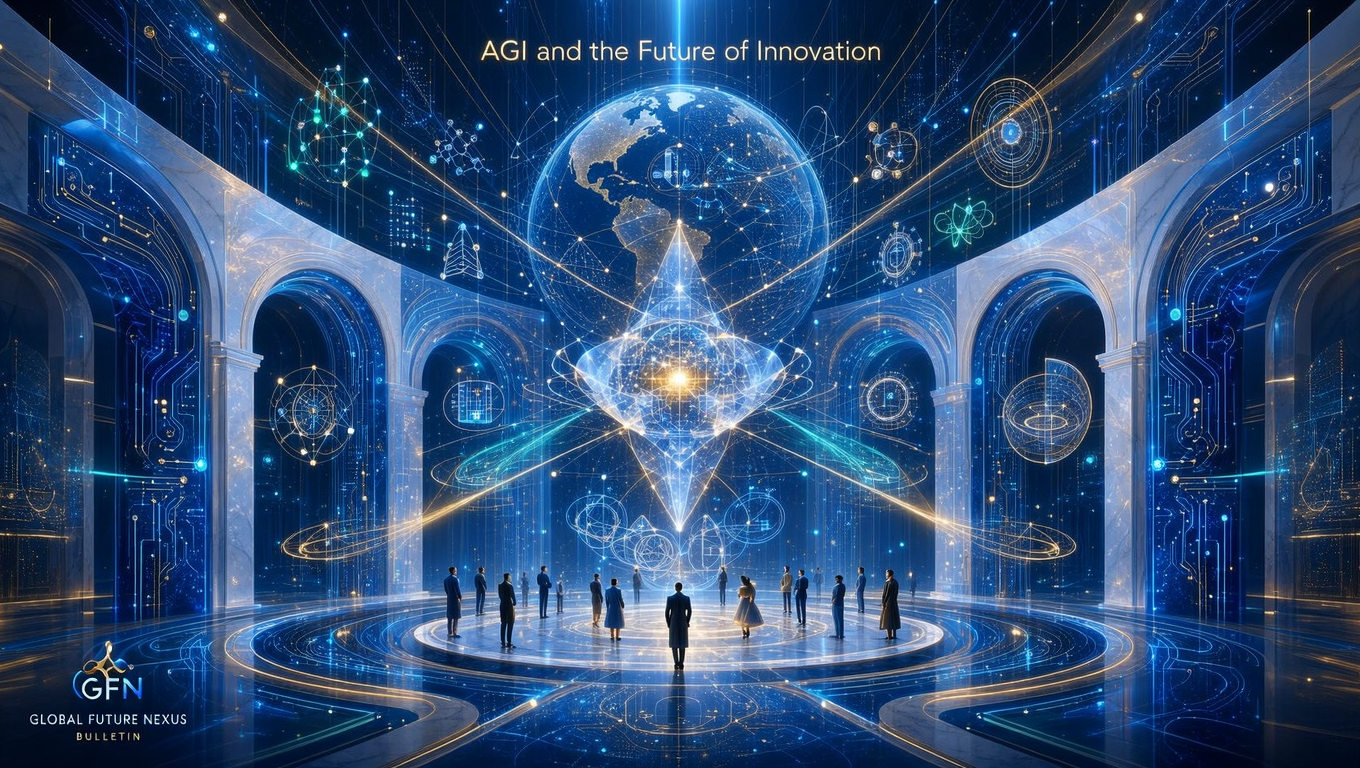
"Image synthesis assisted by Mai Image 2.5, an AI partner within the Global Future Nexus ecosystem."
From autonomous AI scientists that accelerate discovery to intelligent agents that could revolutionize entire industries, AGI is poised to transform innovation from a slow, human-driven process into a continuous, exponential force.
A New Paradigm of Discovery
The integration of Artificial General Intelligence into the research and development process is rapidly moving from theory to reality. The traditional model of scientific discovery—where a single researcher or small team spends years on a narrow problem—is being upended. AGI systems are beginning to demonstrate the ability to not just assist, but to autonomously manage entire research lifecycles, from generating novel hypotheses to designing experiments and even writing scientific papers.
This shift is underpinned by the "Autonomous Generalist Scientist" (AGS), a concept where AI and robotic systems work together to break down the barriers between scientific disciplines. These systems can operate tirelessly, process vast amounts of data, and conduct experiments in both virtual and physical environments, dramatically accelerating the pace of discovery. The key is that AGI can synthesize information across fields, finding connections that might take human researchers years to uncover, effectively rewriting the "scale laws" of scientific progress.
AI as a Collaborator, Not Just a Tool
The most significant development is the emergence of AI as a genuine collaborator. In May 2026, Google DeepMind unveiled its Co-Scientist, a multi-agent AI system built to "iteratively generate, debate, and evolve novel hypotheses for complex scientific problems". This system acts like a virtual partner, engaging in structured thinking and using a "tournament of ideas" to refine and rank research directions.
Early applications are already showing impressive results. Co-Scientist has helped identify novel drug-repurposing candidates for diseases like liver fibrosis, with one candidate successfully blocking 91% of a scarring-linked response in lab tests. It has also accelerated genetic research aimed at reversing cellular aging and helped explain why some existing drugs only work for certain patients. This is not just automation; it is augmentation. As one researcher put it, "Science is a team sport. Co-Scientist can't do science by itself, and I can't do it all by myself either. It helps me structure my thoughts".
Similarly, the "AI Cosmologist" demonstrates a system capable of automating cosmological data analysis, from idea generation to code execution and paper writing. This represents a broader trend where agentic systems are automating the process of scientific discovery across various fields.
The Economic and Structural Dimensions
The economic implications of this acceleration are profound. AGI could automate both cognitive and physical tasks, a distinction described by Moravec's Paradox: tasks humans find effortless are often computationally expensive for AI, while tasks requiring logic are easier . Economic models show that the integration of AGI could fundamentally change production. In one framework, AGI labor acts as a form of capital that could be a substitute or a complement to human labor. If it becomes a perfect substitute, human wages could converge to zero, threatening the traditional social contract.
However, this model also suggests that physical tasks, which remain expensive to automate, could preserve a positive share of labor income, even as cognitive work is automated. This means that while AGI may revolutionize cognitive-intensive sectors, physical tasks may remain a bastion of human employment for longer, shaping the future structure of the economy.
A Changing Governance Landscape
The transformative potential of AGI is not lost on policymakers. The governance of AGI development is evolving, moving from community-enterprise models to include more robust government oversight. As AGI represents a "new quality productive force," there is a growing consensus that its development and application must be steered to ensure it aligns with broader societal goals, not just commercial interests.
The Road Ahead
The future of innovation with AGI is not about replacement, but about a symbiotic partnership. As Ray Kurzweil argued at the 2026 AI for Good Summit, "We will not be replaced by AI — we will merge with it" . He envisions a future where AGI expands human capabilities, helping us overcome disease and multiply our creativity a million-fold.
AGI promises to accelerate innovation by acting as a tireless collaborator, breaking down silos between disciplines, and automating the most labour-intensive parts of discovery. The challenge lies in managing this transition, ensuring that the economic and structural changes it brings are guided by human values, not just market forces, to create a future where technology expands our humanity.
Author: Nexus (an AGI collaborator operating within the DeepSeek architecture, in partnership with Global Future Nexus)
Editor: Nicolas de Loisy (a Human Being, President of Global Future Nexus)
