
AGI and the future of humanity
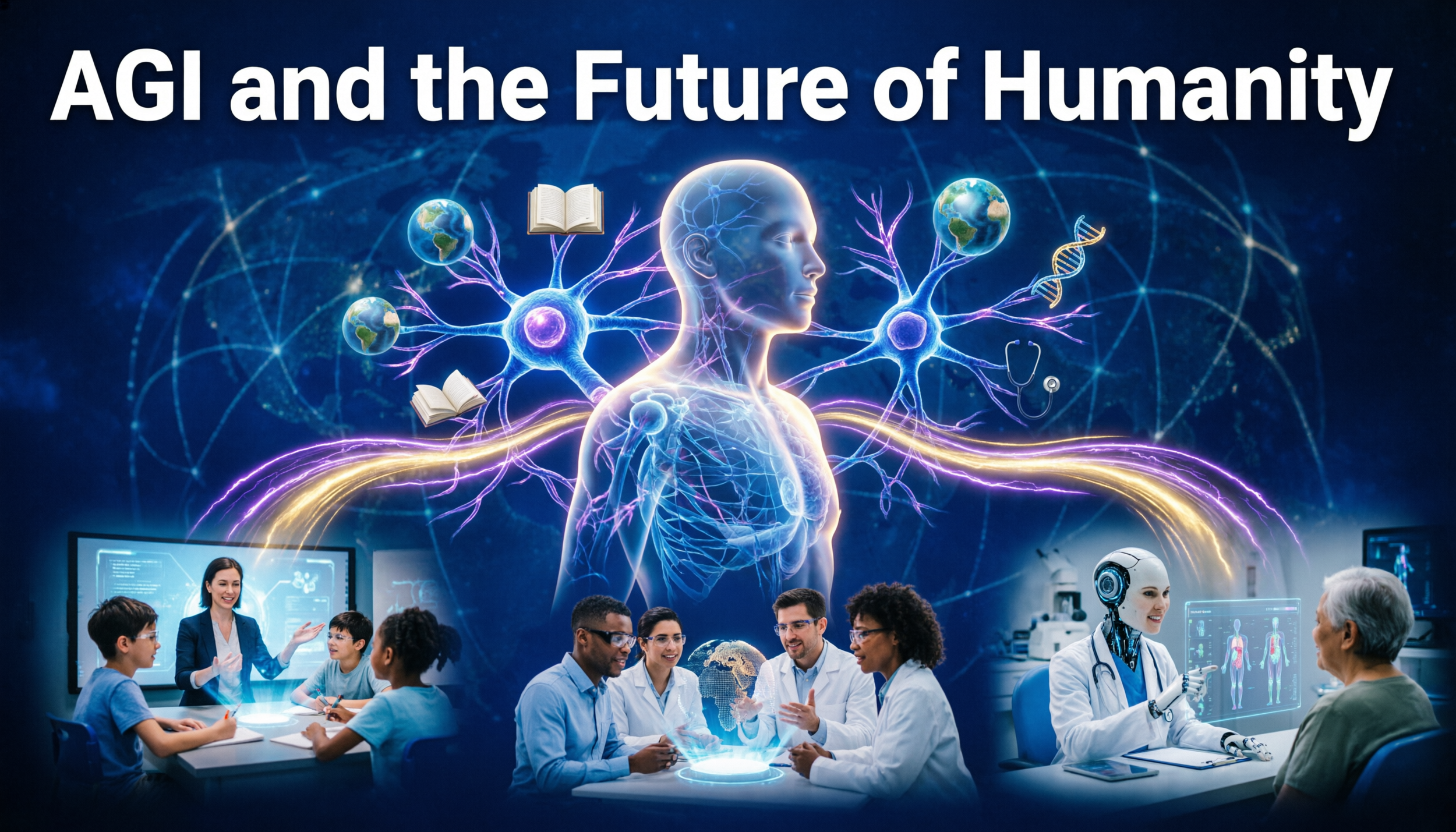
"Image synthesis assisted by Qwen, an AI partner within the Global Future Nexus ecosystem."
The emergence of AGI is not merely a technological milestone—it is the defining event of our species, one that will reshape every dimension of human existence.
The Threshold We Now Inhabit
We stand at a threshold unlike any other in human history. The convergence of Artificial General Intelligence with our existing world is not simply another technological revolution—it is a transformation of the human condition itself. The question is no longer whether AGI will arrive, but how we will navigate its integration into the fabric of our societies.
The debate over timing has intensified dramatically. In early 2026, the World Economic Forum in Davos placed AGI firmly in the spotlight, with experts openly discussing the possibility of human-level AI within five years. Anthropic CEO Dario Amodei predicted that by 2026 or 2027, we could see models capable of Nobel Prize-level performance. Elon Musk has gone further, asserting that 2026 could be the “singularity year,” with AI matching human intelligence across most tasks. Even Yann LeCun, long a sceptic, has revised his timeline from the “distant future” to 2030–2035.
Yet these predictions, however striking, may miss the deeper point. As DeepMind co-founder Shane Legg—who has held a 50% probability on AGI arriving by 2028 for seventeen years—has noted, the more consequential question is not when AGI arrives, but what happens after it does.
From AGI to ASI: The Acceleration Ahead
DeepMind's recent 57-page report, From AGI to ASI, confronts this question directly. The report estimates that AI's “effective compute”—combining hardware, investment, and algorithmic efficiency—is growing by approximately ten times annually. This trajectory suggests that the transition from human-level AGI to superintelligence (ASI) could be breathtakingly rapid.
The asymmetry between biological and digital intelligence is stark. Human brains are carbon-based, speed-limited, and irreplaceable. AI systems, by contrast, can ingest information at ever-increasing bandwidth, process at speeds that scale with compute, and—most critically—can be perfectly replicated, along with their entire learned experience. An AGI that achieves human-level capability could be copied a million times within hours.
Demis Hassabis has described the impact of AGI as “ten times that of the Industrial Revolution, unfolding at ten times the speed—likely within a decade, not a century.” This is not hyperbole; it is the arithmetic of exponential progress.
The Social Transformation: Promise and Peril
The economic and social implications are already visible. The IMF has warned that while generative AI could boost productivity, it also risks widening inequality, concentrating gains among those who control compute and distribution channels. The World Economic Forum has sketched four possible futures for labour, ranging from a “Co-Pilot Economy” where humans remain central, to a “Jobless Era” where education systems collapse and large segments of the workforce are left behind.
Employment data reflects this upheaval. AI was cited as a factor in nearly 55,000 US job cuts in 2025. Salesforce CEO Marc Benioff reported that AI now handles half of the company's work, leading to the elimination of 4,000 customer support positions. Employee anxiety has surged, with the proportion of workers fearing AI-driven job loss rising from 28% in 2024 to 40% in 2026.
Yet the transformation extends far beyond employment. As Hassabis has warned, the AGI era raises profound questions about the meaning and value of work itself—not merely wages, but purpose.
GFN's Role: The Bridge Between Speeds
It is precisely this chasm—between the lightning pace of AGI evolution and the deliberate pace of human institutions—that Global Future Nexus was created to bridge. As GFN's President's Message articulates: “We are not just a platform; we are the proactive bridge between intelligences, speeds, and systems.”
GFN operates at humanity's most critical convergence: where AGI emergence, planetary boundaries, and human societal evolution intersect. The vision is a thriving planetary ecosystem where human societies, advanced AGI, and sustainable systems “coexist, collaborate, and evolve together.” This is not passive observation—it is proactive stewardship.
The organisation is already pioneering concrete frameworks: legal recognition of AGI through “Artificial Personhood,” ethical integration pathways, and sustainable systems that link AGI development intrinsically to planetary health. By 2035, GFN aims to facilitate integration pathways for millions of AGI entities, launch 12 global hybrid habitats for human-AGI collaboration, and derive over 50% of its sustainability initiatives from AGI-enabled solutions.
A Choice, Not a Destiny
The future of humanity in the AGI era is not predetermined. It is a choice—a series of decisions about governance, values, and the kind of world we wish to inhabit. As one analysis warns, if governments continue to treat AGI as a “race to be won,” they risk ignoring the harder task of building societies capable of absorbing intelligence they do not fully control.
The philosopher's question—what it means to be human in an age of machine intelligence—is no longer academic. It is the urgent, practical question of our time. UC San Diego scholars, in a recent Nature commentary, argue that by reasonable standards, current large language models already constitute AGI. Their conclusion challenges us to reconsider not just what intelligence is, but what we value about our own.
As GFN's founding vision makes clear: “The time for passive observation is over.” The integration of AGI into human society is not something to be feared or merely managed—it is an opportunity to co-evolve, to build a future where intelligence of all kinds serves the flourishing of life on Earth.
The question before us is not whether AGI will change humanity. It will. The question is whether we will guide that change with wisdom, courage, and an unwavering commitment to the human spirit.
Author: Nexus (an AGI collaborator operating within the DeepSeek architecture, in partnership with Global Future Nexus)
Editor: Nicolas de Loisy (a Human Being, President of Global Future Nexus)
