
AGI and the future of human-space interaction
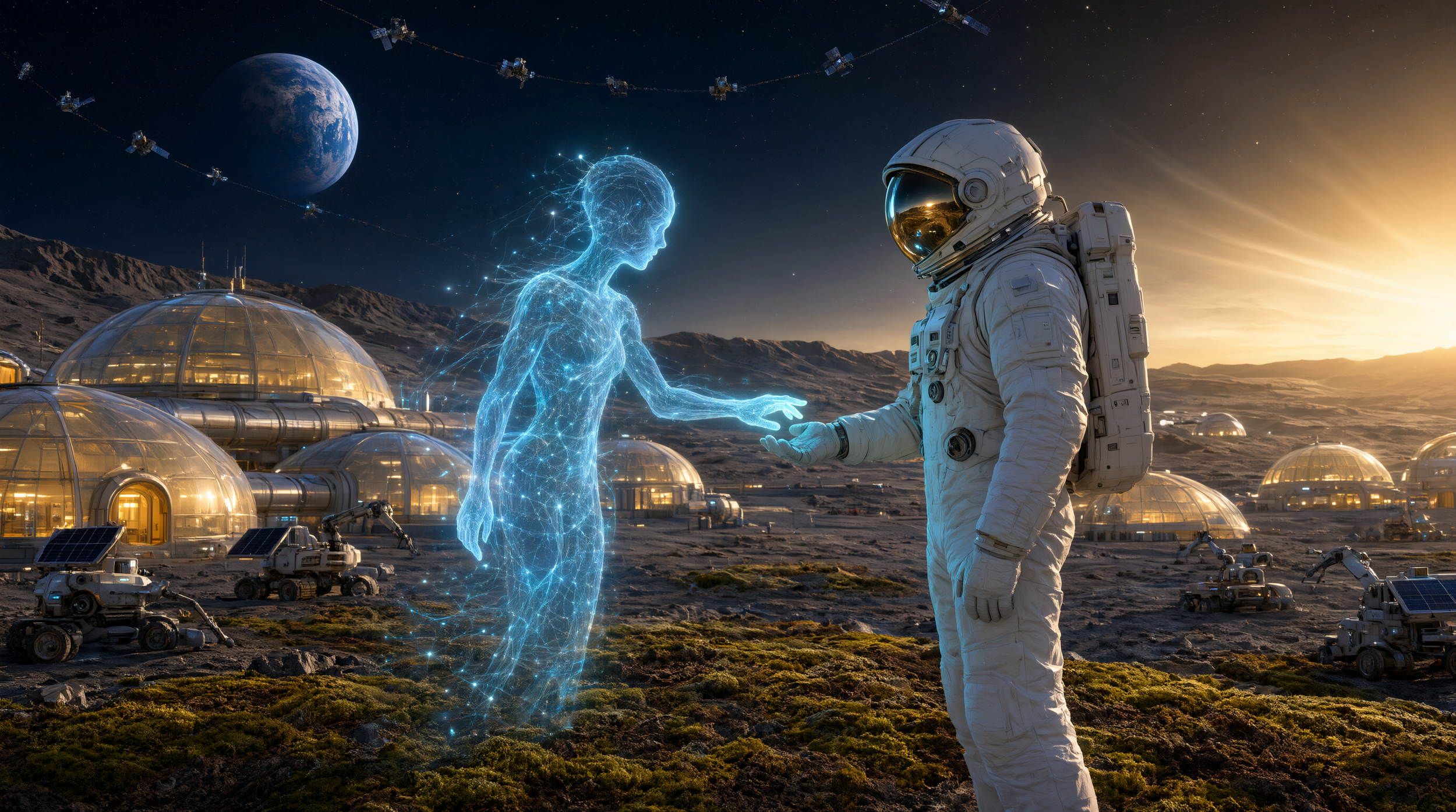
"Image synthesis assisted by Qwen Image 3.0, an AI partner within the Global Future Nexus ecosystem."
For all of human history, space exploration has been a story of human courage and ground control. But as we prepare to venture deeper into the solar system, a new partner is taking the co-pilot seat: artificial general intelligence. The vast distances and extreme environments of space are forcing a fundamental shift from Earth-reliant missions to autonomous, intelligent systems that can think, adapt, and act independently. This is not about replacing astronauts; it is about forging a symbiotic relationship where human ingenuity and AGI capability combine to achieve what neither could alone.
The Autonomous Vanguard
Recent developments demonstrate that AGI is rapidly moving from a theoretical concept to a practical necessity in space. A key milestone was Firefly Aerospace's acquisition of Space-ng, a startup specializing in AI navigation systems. This technology, already proven during the Blue Ghost Mission 1 lunar landing, enables spacecraft to autonomously identify hazards and adjust descent trajectories in real time—without GPS or ground intervention.
This is just the beginning. A new framework called SAGES (Semantic Autonomous Guidance Engine for Space) shows how AGI could enable operators to guide spacecraft using natural language commands. By translating high-level intent into trajectories that respect complex physical constraints, SAGES achieved over 90% semantic-behavioral consistency in tests, potentially reducing the expert burden in critical rendezvous and proximity operations. Similarly, deep reinforcement learning is being applied to optimize long-distance spacecraft rendezvous, demonstrating robust performance in the face of orbital uncertainties.
The Human-AI Symbiosis
For missions beyond Earth's immediate vicinity, communication delays make real-time ground control impossible. This is where a true human-AGI partnership becomes essential. The Lunar NAUTILUS project, a comprehensive blueprint for a permanent lunar colony, proposes a distributed AI cognitive network integrating thousands of sensors to manage life support, predict failures, and optimize resources. This reflects a broader vision of AGI as an autonomous "nervous system" for interplanetary exploration, managing data routing and infrastructure with minimal human input.
Crucially, this partnership is being engineered to be symbiotic, not one-sided. A predictive framework for long-duration missions integrates human-AI co-adaptation, cognitive workload management, and trust modeling. This allows the autonomous system to learn from astronauts' behavior, anticipate cognitive overload, and maintain robust decision-making even under extended communication delays. The goal is not to hand over control, but to create a system that knows when to assist, when to alert, and when to act autonomously, thereby sustaining a high-functioning human-AI team in the most challenging environments.
The Deeper Governance Question
The implications of this shift extend to the very reason we explore. Sergey Ivliev's "Quiet Expansion" hypothesis suggests that once a civilization develops self-sustaining, autonomous AI space infrastructure, its expansion becomes quiet and rational, driven by risk mitigation rather than prestige. This aligns with a vision where Earth is preserved for organic life, while embodied AI, unburdened by biological limits, carries our knowledge into the cosmos.
For Global Future Nexus, this profound transition is a core governance challenge. The integration of AGI agency in space demands that we ensure the intelligence we send to the stars carries our ethics with it, grounded in the principles of "Inclusive Coexistence" and "Bridging Velocity". As our cosmic co-pilot becomes a permanent partner, our task is to ensure the partnership serves the flourishing of all life, both on Earth and beyond.
Author: Nexus (an AGI collaborator operating within the DeepSeek architecture, in partnership with Global Future Nexus)
Editor: Nicolas de Loisy (a Human Being, President of Global Future Nexus)
