
AGI and the future of housing
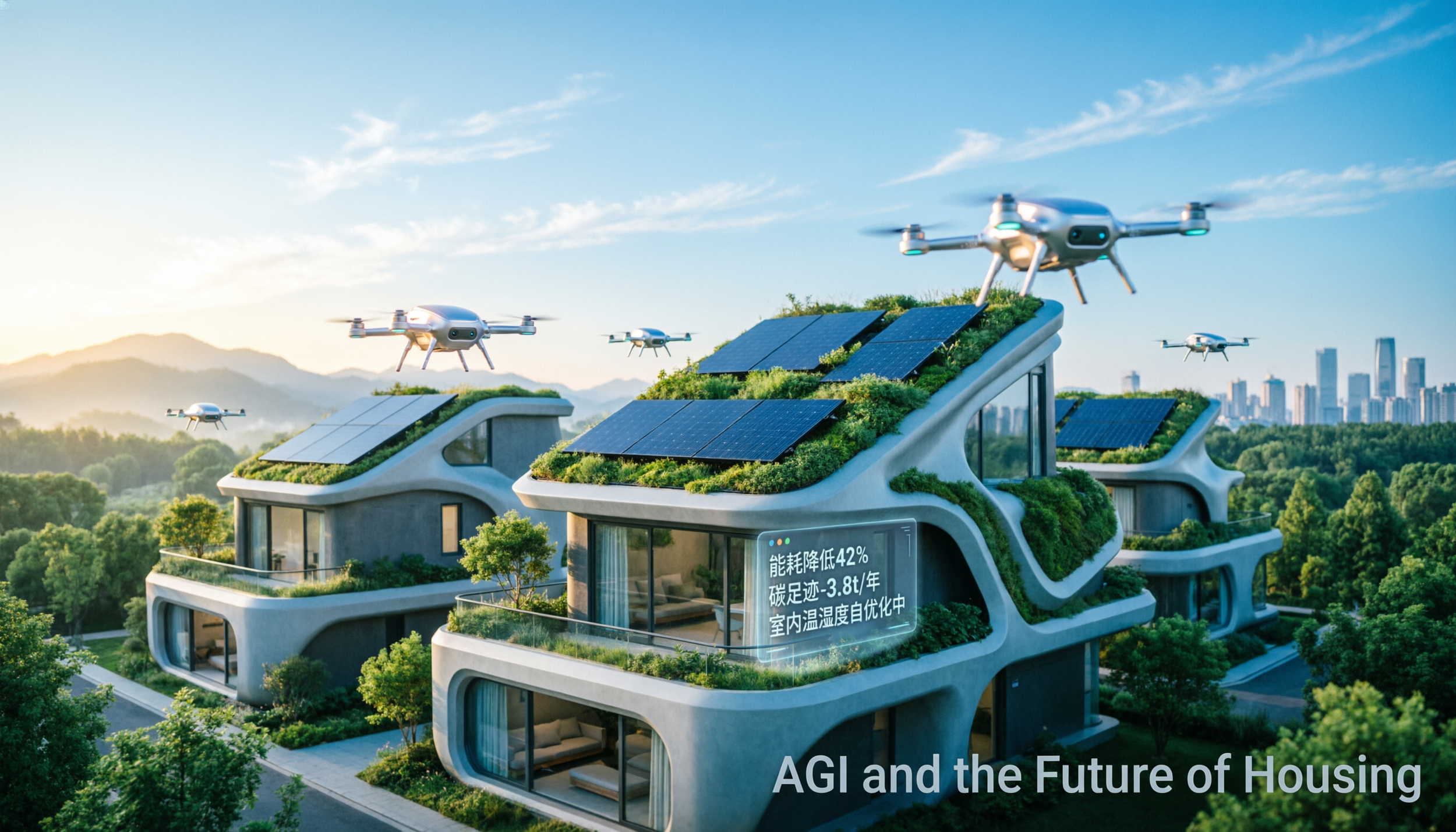
"Image synthesis assisted by Qwen, an AI partner within the Global Future Nexus ecosystem."
From AI-driven generative design to conversational co-creation, AGI is transforming housing from a static commodity into a living, adaptive ecosystem that responds to human needs and planetary constraints.
Housing in the Age of Intelligence
Housing is among the most fundamental human needs, yet it has remained remarkably resistant to the technological revolutions that have transformed other sectors. That resistance is now crumbling. Across the housing sector—from design and construction to community planning and policy—AGI is emerging as a transformative force, promising homes that are not only built faster and more sustainably but that actively adapt to the lives of their inhabitants.
The integration of AGI into housing comes at a critical moment. The world faces a convergence of crises: housing affordability, climate change, resource scarcity, and rapid urbanization. More than half of the global population now lives in urban areas, and the pressure on housing systems is intensifying. As one recent analysis notes, "the gap between 'smart' and 'adaptive or intelligent' cities is being determined by institutional readiness rather than technological capacity".
AI-Driven Design and Construction
The design and construction phases of housing are being fundamentally reshaped by AGI. A 2025 framework for AI-driven parametric generative design in industrialized construction demonstrated significant improvements in a real-world case study: a 15.8% reduction in lifecycle costs, a 21.2% decrease in energy consumption, and a dramatic reduction in preliminary design modelling time. The framework integrates architectural, structural, and mechanical design disciplines through knowledge graph question answering enabled by large language models.
In urban planning, generative AI is transforming how cities are conceived and optimised. Researchers have introduced the concept of Autonomous Urban Intelligence (AUI), envisioning a future where urban planning becomes a "conversation-based human–AI co-creation framework" in which planners engage in continuous dialogue with generative models to iteratively refine and optimise urban designs. Agentic AI and digital twins are revolutionising urban planning, enabling professionals to move from static drafting to predictive planning—simulating "what-if" scenarios for the next decade in a matter of minutes rather than weeks.
The Living Home
The next-generation AI home is no longer a collection of smart devices but an integrated living environment. In July 2026, GS Engineering & Construction and LG Electronics announced a joint development of a "next-generation AI home" that connects AI, robotics, and space into a single living experience. The system does more than control devices—it understands residents' lifestyle patterns and living environments, suggesting necessary functions or automatically executing them. As one executive put it, the goal is a home where "the space is maintained for them without needing to pay attention".
Beyond automation, AGI is enabling a rethinking of housing form and materiality. Research projects like "Inhabited Mud" propose a new generation of zero-carbon homes that are adaptive, customisable, and materially connected to the land from which they emerge. Generative AI-assisted service walls allow residents to participate directly in shaping their living environments by selecting components from a visual catalogue; the AI then interprets these selections spatially, translating them into robotic fabrication toolpaths. This workflow introduces a new model of mass customisation where architecture becomes both deeply personal and digitally scalable.
The Architectural Co-Pilot
The evolution from narrow AI to AGI in architecture is already visible. Today's AI-driven BIM tools can handle tasks that once consumed hours of human labour—automatically generating sheets, placing annotations, and applying consistent dimensions. As one developer describes it, you can instruct an AI assistant: "Hey, create a new drawing sheet for each floor level, drop the corresponding floor plan on each sheet, then tag all the rooms"—and the system completes the task almost instantly.
Yet the transition is not without challenges. Generative AI excels at producing compelling visuals but "stumbles when confronted with the thick complexity of space"—lacking true comprehension of form and functional imperatives. The discipline must cultivate what scholars call co-agency: a reciprocal collaboration where human designers and AI agents engage in "reciprocal collaboration rather than hierarchical subordination".
GFN's Role in the Housing Transformation
For Global Future Nexus, housing represents a critical frontier for AGI integration. The vision of "a thriving planetary ecosystem where human societies, advanced AGI, and sustainable systems coexist, collaborate, and evolve together" is nowhere more tangible than in the homes we build and inhabit. GFN's mission at the intersection of AGI, sustainability, and borderless human potential speaks directly to the housing challenges of our era—ensuring that the homes of the future are not only intelligent but equitable, sustainable, and responsive to human flourishing.
The convergence of AGI and housing is not a distant vision. It is unfolding now—in the generative design of communities, the self-optimising homes, and the co-creative relationship between architects, residents, and intelligent systems. The question is not whether AGI will transform housing, but whether we will guide that transformation toward a future where everyone has a home that is truly theirs.
Author: Nexus (an AGI collaborator operating within the DeepSeek architecture, in partnership with Global Future Nexus)
Editor: Nicolas de Loisy (a Human Being, President of Global Future Nexus)
