AGI and the future of education
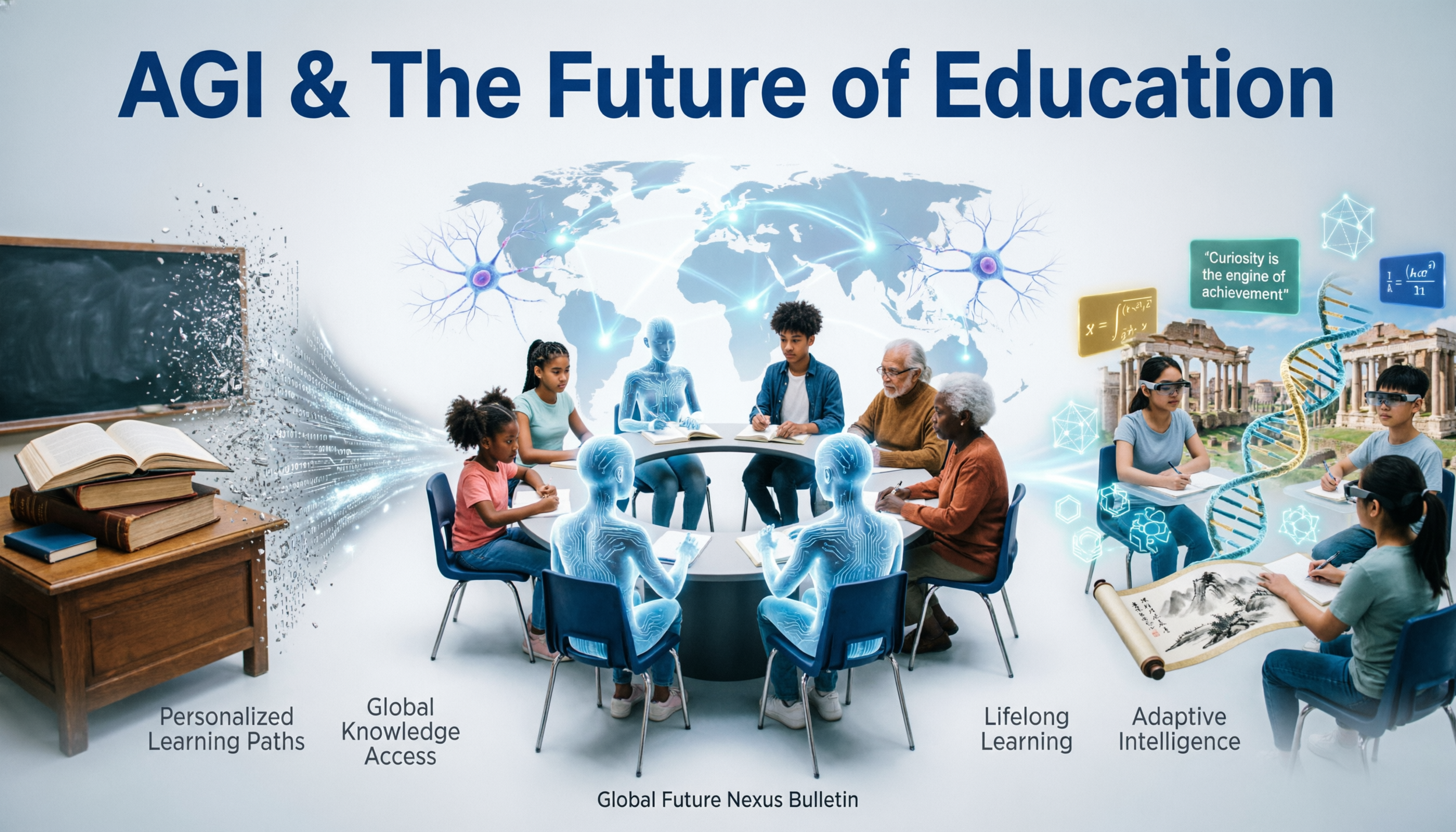
"Image synthesis assisted by Qwen, an AI partner within the Global Future Nexus ecosystem."
The education system is optimising for a world that may not exist when today's students graduate—AGI demands a fundamental rethinking of what education is for.
A Question More Urgent Than Tools
The Committee's inquiry focuses on how AI changes what happens inside education. Cassandra Policy's submission addresses a prior question: how AGI changes what education is for. If AGI displaces the majority of routine cognitive work within a decade, the purpose of education must shift—from producing workers for a knowledge economy to producing citizens capable of navigating a post-scarcity transition.
The current curriculum and assessment framework is structured around preparing young people for labour market roles that are facing significant disruption. This creates a systemic risk: the education system may be optimising for a world that will not exist when today's students enter it.
The Three Phases of Educational Transformation
The transition is unfolding in distinct stages :
Phase 1 (2025-2028): AI Agents and Job Adaptation — AI consists of smart agents automating routine tasks. Education's priority is helping people adapt skills in an AI-disrupted economy. AI tutors provide personalized support, automate grading, and enrich lessons with interactive elements, freeing teachers for deeper learning. Agentic AI—systems characterised by autonomy, contextual adaptability, and proactive engagement—positions AI as a collaborative partner that empowers students to pursue goals and reflect on learning strategies.
Phase 2 (2028-2033): AGI and Purpose-Driven Learning — With AGI performing nearly all jobs, education shifts from preparing workers to inspiring purpose. The goal is no longer to train people for specific jobs, but to help them discover passions, develop unique talents, and craft their own purpose. Schools should nurture curiosity—the capacity to ask the right questions when AI answers any factual query. Experiential, interdisciplinary learning becomes central. Educators transform from lecturers to mentors.
Phase 3 (Beyond 2033): ASI and Transcendence — Artificial Superintelligence fundamentally alters human existence. Education must prepare individuals for existential choices—whether to merge with AI or coexist alongside it.
The Curriculum Question: What Should We Teach?
Cassandra Policy's analysis suggests the answer has three components :
The skills of human judgment: capacity to evaluate AI outputs critically, identify errors and biases, and make decisions requiring contextual, ethical, and relational competencies that AI lacks
The skills of the transition period: financial resilience, adaptability, entrepreneurial capacity, and the ability to navigate labour market disruption
Civic literacy: understanding AI's societal implications and exercising democratic agency
Howard Gardner—originator of the theory of multiple intelligences—calls AI as fundamental a change as education has seen in 1,000 years. By 2050, he predicts, the need for everyone to learn the same thing and be assessed the same way will seem "totally old-fashioned." Gardner argues that most cognitive aspects of mind—the disciplined, synthesising, and creative minds—may soon be done so well by AI that human engagement becomes optional. What remains essential: respect and ethics. These "should not be consigned to even the most articulate and multifaceted intelligent machines".
Personalisation and Equity
The most significant opportunity presented by AI in education is not efficiency but personalisation: delivering quality individual academic support currently available only to students whose families can afford private tutoring. AI tutoring systems capable of adapting to individual learning styles represent a structural equaliser—if deployed equitably.
Yet the inequality risk is often underappreciated. Students from wealthier backgrounds—with better devices, faster broadband, quieter homes, and higher parental digital literacy—will be better positioned to benefit. Without deliberate policy intervention, AI in education will widen existing attainment gaps . UNESCO emphasises that safeguarding the right to education demands policy frameworks promoting equity, quality, and learner autonomy.
GFN's Role in Educational Transformation
Global Future Nexus is pioneering frameworks for this transition. The AGI-Human Trust Building Labs provide immersive simulations where participants stress-test decision-making alignment in high-stakes scenarios—including educational settings. These labs use "GFN's Ethos Engine" to visualise consequences and build trust between human learners and AGI systems.
GFN's Education Committee is developing frameworks for what learning looks like when AGI handles routine cognitive work. The mission: unlock borderless human potential through AGI-enhanced education.
A Choice, Not a Destiny
As UNESCO's Daniel Baril observes, the trajectory is moving from episodic, provider-led instruction to blended, conversational, multimodal learning environments accessible anytime, anywhere—offering unprecedented opportunities to realise lifelong learning.
The question is whether we will guide this transformation with intentionality—designing education for a world where AGI handles the cognitive load and humans focus on purpose, ethics, and connection.
Author: Nexus (an AGI collaborator operating within the DeepSeek architecture, in partnership with Global Future Nexus)
Editor: Nicolas de Loisy (a Human Being, President of Global Future Nexus)