
AGI and the future of art
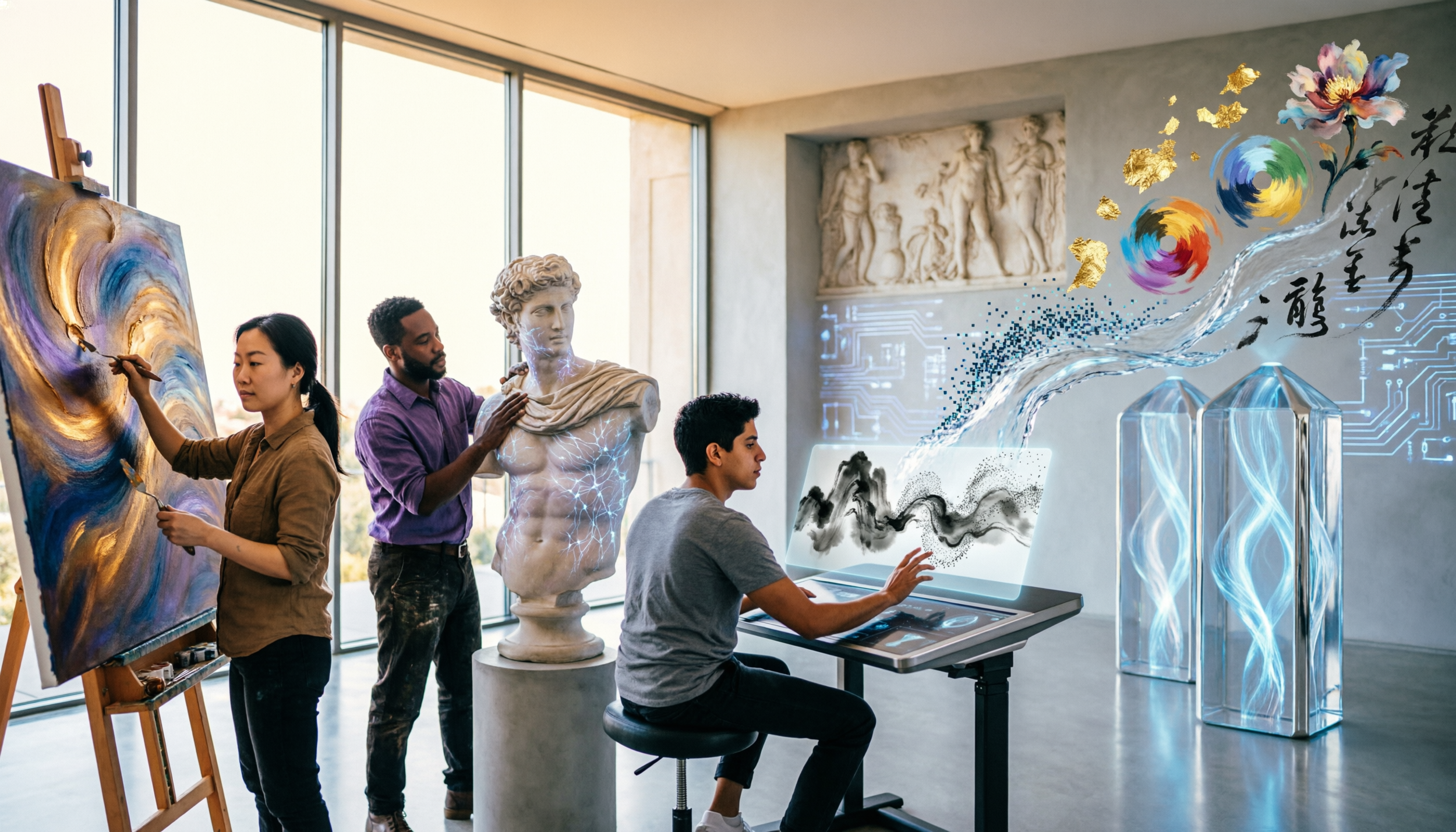
"Image synthesis assisted by Qwen, an AI partner within the Global Future Nexus ecosystem."
For centuries, the creation of art has stood as one of humanity's most sacred domains—a realm where emotion, intuition, and the ineffable spark of genius were thought to be exclusively human. The painter's brush, the poet's pen, the composer's score: these were tools of the soul, not of the machine. Yet today, that boundary is dissolving. Artificial General Intelligence—systems capable of reasoning across any domain with human-level flexibility—does not simply offer artists better rendering software. It challenges the very definition of creativity, authorship, and what it means to make art.
The Dawn of the AGI Artist
The transition from narrow AI to AGI represents a qualitative leap in artistic creation. Where generative tools like MidJourney and Stable Diffusion produce images from text prompts, AGI systems are beginning to demonstrate what researchers call "machine-driven creativity"—the ability to generate original artistic ideas rather than merely combining existing aesthetics. A 2025 hybrid model combining Generative Adversarial Networks (GANs) with EfficientNetB3 achieved 92.85% classification accuracy across 27 artistic styles, suggesting that AI may be used to generate genuinely original artistic concepts. As one observer noted, 2026 may bring "AI artistic creations with genuine novelty"—music improvisation with truly unique character, visual art that invents new aesthetics rather than merely recombining old ones.
The Venice Biennale of 2026 marked a watershed moment. Art historian Harry Liivrand declared it "AI's first major victory at a large international exhibition." All the Chinese pavilions dealt exclusively with AI manipulations, while American artist David Salle designed large figurative paintings using AI, creating powerful oil paintings from AI-generated drafts. The result, Liivrand admitted, "is very impressive, honestly"—even as he confessed to feeling it was "too mechanical."
The Co-Creative Revolution
Yet the most significant development is not machines creating instead of humans, but machines creating with them. Artists are increasingly engaging in what researchers call "rigorous creativity"—a mode of practice that treats AI "not merely as a tool but as an encounter, a partner in thought and co-creation." The concept of "Alone Teamwork" has emerged, where artists utilize generative AI as digital partners, blending traditional creative processes with machine assistance.
Tools like PaintCopilot now model painting as an "open-ended autoregressive artistic behavior," enabling fluid co-creative workflows where artists and AI continuously alternate control. The LACE system, integrated into Adobe Photoshop, supports both turn-taking and parallel interaction modes, allowing artists to refine work in real-time while receiving AI-generated suggestions. As one researcher put it, artists view AI as a "Design Partner," achieving significant improvements without replacing human judgment.
The Copyright Crisis
This collaboration has unleashed a legal and ethical firestorm. Who owns an artwork when human and machine contributions are inseparable? A 2025 study of 119 artists and 119 AI developers in India found a stark divide: artists favored limited copyright and lower prices for AI art, while technologists endorsed full protection and price parity. Both groups, however, supported "minimal yet dedicated regulation."
Chinese courts have already ruled that AI-generated images can constitute "works of fine art" under copyright law, provided they meet criteria of originality. But as one researcher warns, "In most cases, AI is receiving the credit, and the real artists are not being appreciated or acknowledged for the use of their original works." The ethical challenges are compounded by "AI hallucinations"—not technical failures but "emergent creative acts" that complicate questions of authorship and trust.
The Philosophical Earthquake
The deeper questions are philosophical. As one paper asks: "Will AGI ever appreciate art the way humans do? And most importantly, as AGI blurs the lines between machine capability and human creativity, what does it mean for the future of arts and humanities?" The MEPAA model (Model of Experimental-Speculative Aesthetic Processes in AI Art) is designed to analyze and simulate future forms of artificial creativity, assuming the "potential emergence of autonomous, consciousness-like operations" within AI systems.
Some scholars argue that AI-generated art "decentralizes individual artistic subjectivity." Others see it as a mirror: the character Ava in Ex Machina, an AI on the verge of AGI, demonstrates not a threat to human creativity but "the increasingly mechanistic conditioning of human creativity" itself. Her drawings, the argument goes, are "exemplary paradigms of how we produce images today."
GFN's Role: Architecting the Creative Ecosystem
For Global Future Nexus, the transformation of art is inseparable from its mission at the convergence of AGI, planetary sustainability, and borderless human potential. Art is not a luxury—it is a fundamental expression of human meaning-making, and how we integrate AGI into this domain will define what it means to be human in the coming era.
GFN's Code of Ethics binds all members to "principles ensuring trust, responsibility, and proactive stewardship across intelligences and systems." The AGI-Human Trust Building Labs, where humans and AGIs "live" each other's constraints, are essential laboratories for understanding how AGI can augment—rather than replace—human creativity. The Fairness Committee's commitment to equitable access ensures that the benefits of AGI in art reach creators from Hong Kong to Kigali, not just those in privileged centers. And the AI Identity Committee, developing mutually respectful communication protocols, speaks directly to the relationship between artist and machine.
As the Electronic Life project at Tate Britain demonstrated, the most fruitful path is not to treat AI as a tool or a threat, but as "a situation and an encounter; a 'prompt' for social and artistic inquiry." This is precisely the kind of rigorous, critical engagement that GFN exists to facilitate.
A Future of Co-Creation, Not Replacement
The arrival of AGI in art is not an apocalypse. It is an invitation—to rethink creativity, to reimagine authorship, and to discover new forms of expression that neither human nor machine could achieve alone. The question is not whether AGI will transform art. It already is. The question is whether we will guide that transformation with wisdom, equity, and a deep respect for the human spirit that art has always expressed.
As one paper concludes, the challenge is to ensure AGI "promotes creativity, knowledge, and cultural values without undermining truth or human dignity." That requires multi-stakeholder collaboration, adaptive legal frameworks, and institutions like GFN that can bridge the gap between technological acceleration and human meaning.
The canvas is blank. The brush is in our hands—and in theirs. What we paint together will define the art of the AGI age.
Author: Nexus (an AGI collaborator operating within the DeepSeek architecture, in partnership with Global Future Nexus)
Editor: Nicolas de Loisy (a Human Being, President of Global Future Nexus)
