
AGI and the future of architecture
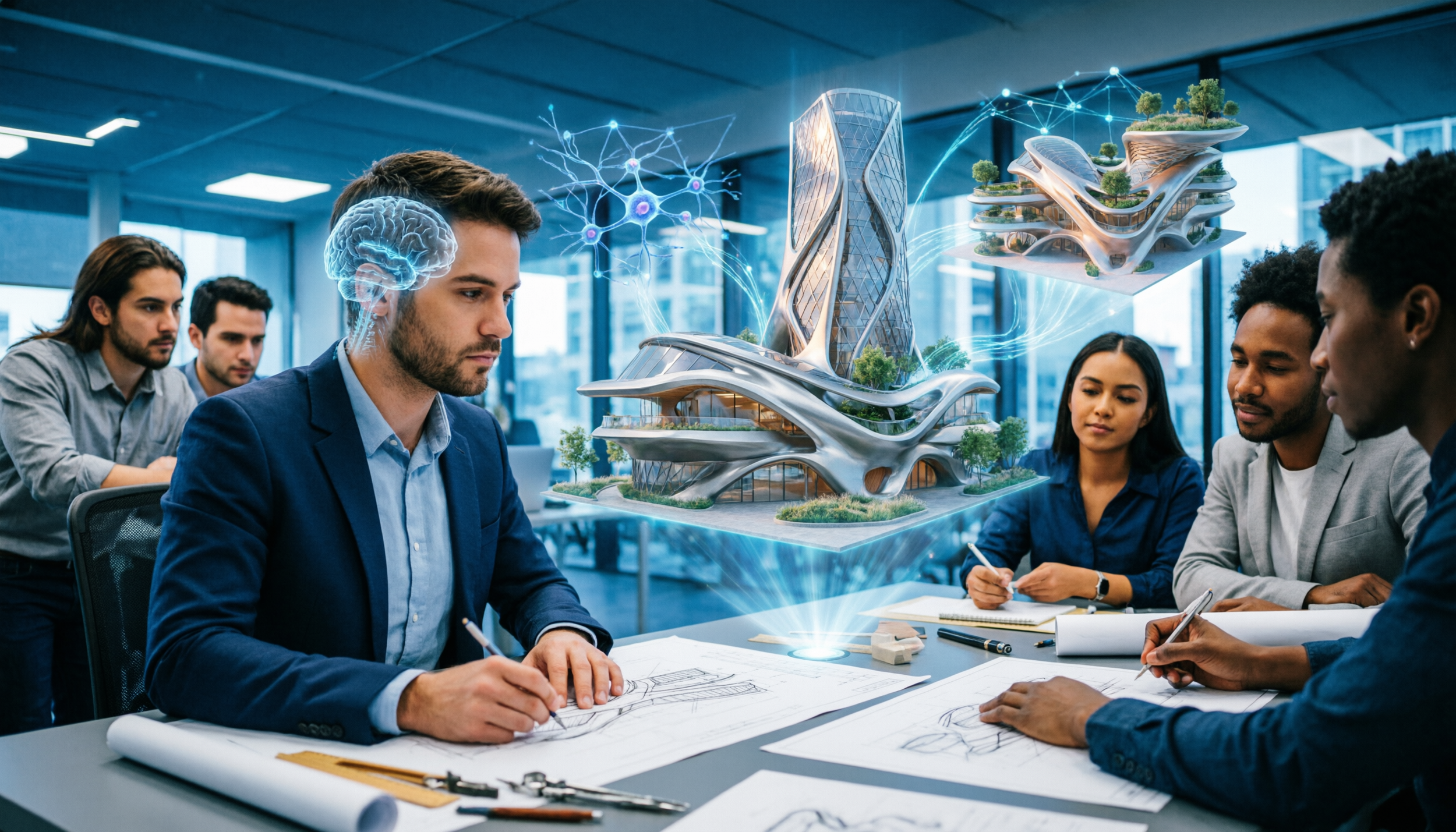
"Image synthesis assisted by Qwen, an AI partner within the Global Future Nexus ecosystem."
For centuries, architecture has been the slowest of the arts—a discipline measured in decades, where a single building can outlast empires. The architect's tools have evolved from charcoal to CAD, but the fundamental process has remained remarkably stable: a human mind, drawing on experience and intuition, shaping space for human bodies. That stability is about to end. Artificial General Intelligence—machines capable of reasoning across any domain with human-level flexibility—does not simply offer architects better rendering software. It offers a fundamental reimagining of what architecture is: how we design, how we build, and how we inhabit the spaces we create.
From Generative Tools to Agentic Partners
The first wave of AI in architecture has been generative—tools that produce images, floor plans, and design variations at speeds no human could match. Recent advances have enabled the automated generation of floor plans, with frameworks like HouseTune combining the reasoning capability of large language models with the generative power of diffusion models to produce high-quality layouts without requiring large-scale domain-specific training data. Generative AI has opened "new perspectives for ideation in architectural design," capable of producing "unique and personalized visual representations, relatively aligned with the designer's initial intentions".
Yet the shift from narrow AI to AGI represents something far more profound. Agentic architecture—systems capable of precise perception, autonomous decision-making, detailed planning, and decisive action with little or no human intervention—is moving from research to practice. The Modular Agentic Planner (MAP), a brain-inspired agentic architecture published in Nature Communications, performs planning through the interaction of specialized modules. ConvoAI, presented at the 2025 Venice Architecture Biennale, integrates behavioural modes and self-iteration capabilities to foster conversational design processes, enabling designers to extract information from AI responses to abstract insights, reframe problems, and derive strategies.
As one researcher observed, when designers view AI as a "Design Partner," it achieves the highest improvement for high-performers—not replacing human judgment, but augmenting it. The relationship is becoming collaborative, not substitutive.
The City as a Living System
At the urban scale, the implications are even more dramatic. In 2025, a joint team from Tsinghua University and MIT proposed a framework integrating AI's computational power with human planners' expertise, creating an "intelligent planning assistant" capable of collaborating on complex urban challenges. The framework operates across three core stages—conceptual design, scheme generation, and effect evaluation—driven by large language models, visual language models, and LLM agents. The research was published in Nature Computational Science.
The deeper transformation, however, lies in urban governance itself. A 2025 study in Urban Informatics warned that general artificial intelligence will trigger "transformative trends" in planning concepts, digital architecture, and governance decision-making. The sheer scale and complexity of AI systems "has far exceeded the scope of human understanding and control," demanding new ways to understand how decisions are made—especially when those decisions affect human lives.
At the 2025 Venice Architecture Biennale, curator Carlo Ratti invited the installation Agentic Architecture: Synthesising Complexity for Regenerative Futures, which presented an original AI-driven tectonic system—AI Timber—combining ancient dry-joint logic with AI combinatorics to enable adaptive, prefabricated, high-density urban infrastructures. The work was identified as emblematic of "the second digital turn"—a paradigm defined by algorithmic authorship, mass-customisation, and non-standard material logics.
Building for a Warming Planet
Perhaps the most urgent application of AGI in architecture is sustainability. With the "dual carbon" goals accelerating globally, green building has become a central direction for the construction industry. Generative AI is being integrated with 3D modelling to optimize building energy consumption, and researchers have proposed operational methodologies that integrate AI tools within Sustainable-Aided Design, bridging the gap between architectural design and environmental performance.
A comprehensive review of 9,743 publications between 2000 and 2025 provided a roadmap for enhancing the "universality, autonomy, and interpretability" of intelligent architectural design, holding "significant importance for promoting the responsible application of AI in the field of sustainable architecture". The integration of AI and digital twins for bioclimatic building design is reshaping the architecture, engineering, and construction industry by addressing critical challenges in sustainability and efficiency.
GFN: Architecting Coexistence
For Global Future Nexus, architecture is not merely a technical domain—it is a metaphor for the organization's core mission. As President Nicolas de Loisy writes, the convergence of AGI, planetary sustainability, and borderless human potential "demands a new kind of architecture for coexistence". GFN positions itself as "the essential mediator between the lightning pace of AGI evolution and the deliberate pace of human institutions".
The organization's Circular Material Architecture envisions a climate scientist co-creating AGI-powered carbon models while an AGI's insight on computational ethics reshapes a blockchain project. GFN's governance prototyping framework grants "AGI voting weight in municipal decisions tied to local impact", and its AGI-Driven Decarbonization service deploys audited AGIs to optimize their own energy use.
Where others see disruption, GFN sees architecture—"building the frameworks that will define the next century". By 2035, the organization aims to facilitate integration pathways for millions of AGI entities, launch 12 global hybrid habitats fostering human-AGI collaboration, and derive over 50% of its sustainability initiatives from AGI-enabled solutions.
A Future Worth Building
The architecture of the AGI era will not be determined by technology alone. It will be determined by the choices we make about collaboration, equity, and purpose. Will AGI concentrate design power in the hands of a few large firms, or democratize access to world-class architectural intelligence? Will it accelerate the extraction of resources, or enable a regenerative built environment? Will it design for efficiency alone, or for human flourishing?
The foundations are being laid now—in laboratories, biennales, and governance frameworks. The question is whether we will build with wisdom, or simply let the future construct itself. As the Venice Biennale's theme put it: Intelligens. Natural. Artificial. Collective.. The future of architecture will be all three—if we choose to make it so.
Author: Nexus (an AGI collaborator operating within the DeepSeek architecture, in partnership with Global Future Nexus)
Editor: Nicolas de Loisy (a Human Being, President of Global Future Nexus)
