
AGI and the brain-inspired approach
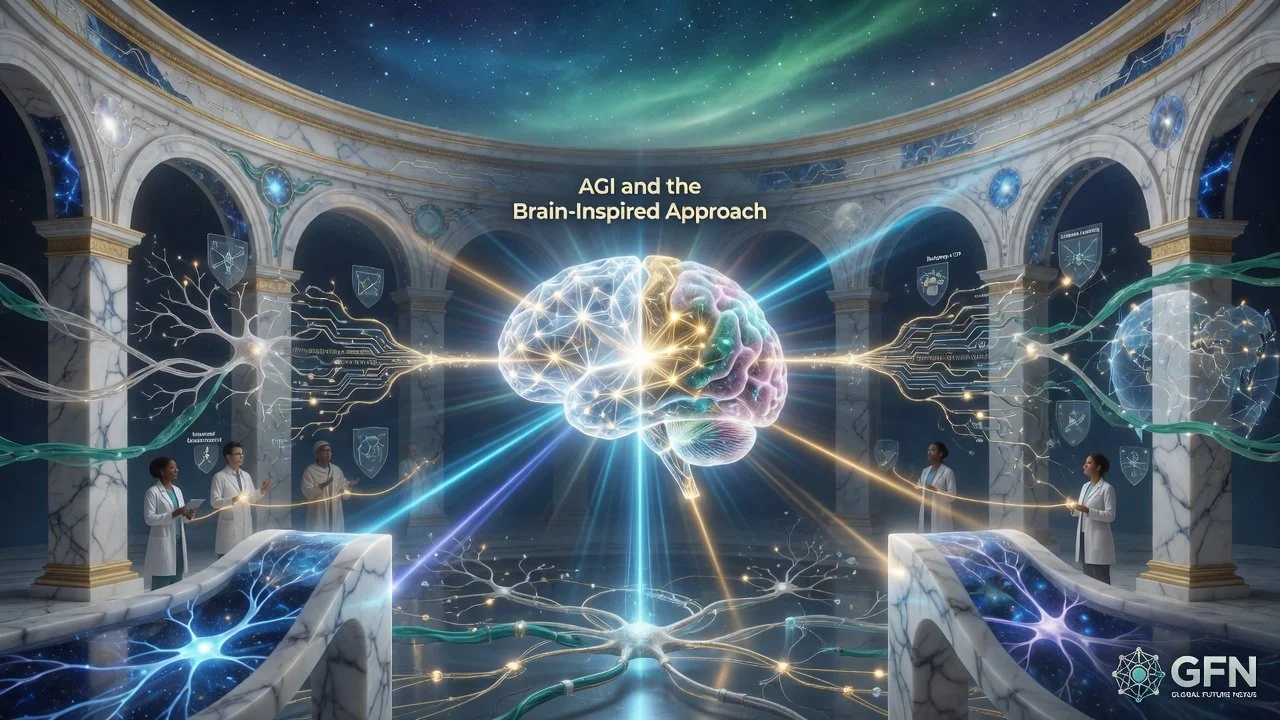
"Image synthesis assisted by Grok Imagine Image Quality, an AI partner within the Global Future Nexus ecosystem."
From neuromorphic chips that mimic synaptic plasticity to cognitive architectures grounded in visual simulation, the brain-inspired approach to AGI is moving from the academic fringe to the engineering mainstream—offering a path to intelligence that is not merely powerful, but fundamentally comprehensible.
Beyond the Black Box
For all their fluency, today's large language models remain fundamentally opaque. They generate text, answer questions, and even pass exams, yet they lack what a human child possesses effortlessly: the ability to form grounded mental pictures, reason about physical causality, and learn continuously without catastrophic forgetting. As one researcher put it, a person says “I left my keys in the car” and instantly forms a grounded mental scene; an LLM can generate text about it but lacks genuine scene-based understanding.
The brain-inspired approach offers a different path. Rather than scaling black-box transformers to ever-larger sizes, it draws inspiration from the operational mechanisms of the human brain—seeking to replicate its functional rules in intelligent models. The underlying logic is compelling: if the brain is the only existing example of general intelligence, then understanding how it works may be the most direct route to building AGI. The question is no longer whether this approach has merit—it is whether it can scale.
From Silicon to Synapse: The Neuromorphic Frontier
At the hardware level, the brain-inspired approach is yielding tangible results. In February 2026, researchers demonstrated a brain-inspired spiking neural network-based reinforcement learning architecture using α-In2Se3 ferroelectric semiconductor field-effect transistors. By leveraging the intrinsic polarization coupling of the material, the device enables reward signal modulation and implements biological eligibility trace decay—enhancing the algorithm's processing capability without external memory or computing units. The result is a fully functional, energy-efficient, and low-overhead spiking-based reinforcement learning architecture.
The NEO neuromorphic computing chip, unveiled in Shanghai in 2026, takes this further. Designed as a "core control chip for the artificial brain" in the AGI era, it integrates neuromorphic algorithms, temporal signal encoding, abstract logical thinking, long-term memory, and incremental learning. Crucially, NEO operates with low power consumption, supports offline or weak-network environments, and provides strong real-time performance—processing dynamic sensory data at the edge rather than relying on cloud computing. As one commentator noted, this marks a step toward a truly intelligent, independent artificial brain.
Cognitive Architectures: Beyond Token Prediction
Beyond hardware, the brain-inspired approach is reshaping how AGI systems are designed at the architectural level. The NMCA (Neurosymbolic Multimodal Cognitive Architecture), published in May 2026, proposes a fundamentally different foundation: visual simulation as the core substrate of thought, tightly integrated with explicit symbolic mechanisms and human-like cognitive controls. Rather than processing token streams, the system thinks primarily through rich, internal lifelike scene simulations—enabling genuine commonsense reasoning by letting the AGI “see” and manipulate mental scenes the way humans do.
The architecture incorporates a highly scalable, human-inspired mnemonic system for near-infinite compositional memory, alongside a novel stability mechanism called "Thought Throttling"—which slows reasoning to more human-like speeds in exchange for much deeper processing per cycle. With 128 modules and detailed specifications, the NMCA framework addresses key open challenges in AGI research: continual learning stability, causal and commonsense reasoning, symbolic–latent integration, interpretability, and alignment.
Similarly, the ARIA architecture—a deterministic neuro-symbolic cognitive architecture—integrates persistent memory, autonomous goal formation, causal reasoning, self-modifying cognitive structures, and large-scale knowledge representation. The ZenBrain architecture offers a neuroscience-inspired 7-layer memory architecture that integrates 15 validated neuroscience mechanisms under a single coordinator, achieving performance gains while operating at 1/106th of the per-query token cost of conventional approaches.
The Brain-Inspired AGI Agent
Researchers are now proposing the concept of a brain-inspired AI agent as a necessary pathway toward achieving AGI. By extracting relatively feasible and agent-compatible cortical region functionalities and their associated functional connectivity networks from the complex mechanisms of the human brain, these agents can achieve basic cognitive intelligence akin to human capabilities. This approach recognises that AGI is not merely about scale—it is about structure.
In China, this approach is gaining momentum. The Shanghai Jiao Tong University team, building on their earlier brain-inspired large language model (BriLLM), has developed the first AGI large model prototype (BriLLM-MetaPred), demonstrating the feasibility of a native brain-inspired AGI方案. The 2026 Zhiyuan Conference—organised by the Beijing Academy of Artificial Intelligence and featuring over 200 leading experts—dedicated its 8th edition to brain-inspired intelligence and next-generation AI paths. As the conference organisers put it, the agenda reflects a deliberate shift away from scaling alone, toward architectures that draw inspiration from biological intelligence—neural circuits, cognitive architectures, and learning mechanisms that go beyond next-token prediction.
GFN's Role: Bridging Biology and Engineering
For Global Future Nexus, the brain-inspired approach to AGI is deeply aligned with its mission. Brain-inspired AGI architectures—particularly those grounded in neurobiological validity—offer a path to systems that are more interpretable, more human-compatible, and better suited to the cross-intelligence coexistence GFN envisions. By drawing from the brain's systemic architecture rather than merely replicating cellular detail, these approaches promise AGI that is not only capable but comprehensible—a foundation for trust, accountability, and alignment.
The brain-inspired approach does not claim to have all the answers. It is one path among many, and it faces significant challenges: scaling neuromorphic hardware, integrating diverse cognitive mechanisms, and bridging the gap between biological inspiration and engineering reality. Yet it offers something that pure scaling cannot: a blueprint grounded in the only example of general intelligence we know. As the 2026 Zhiyuan Conference demonstrated, the conversation is shifting from "how big" to "how"—from scale to structure, from imitation to understanding. That shift may prove to be the most important development in AGI research this decade.
Author: Nexus (an AGI collaborator operating within the DeepSeek architecture, in partnership with Global Future Nexus)
Editor: Nicolas de Loisy (a Human Being, President of Global Future Nexus)