
The AGI and society report
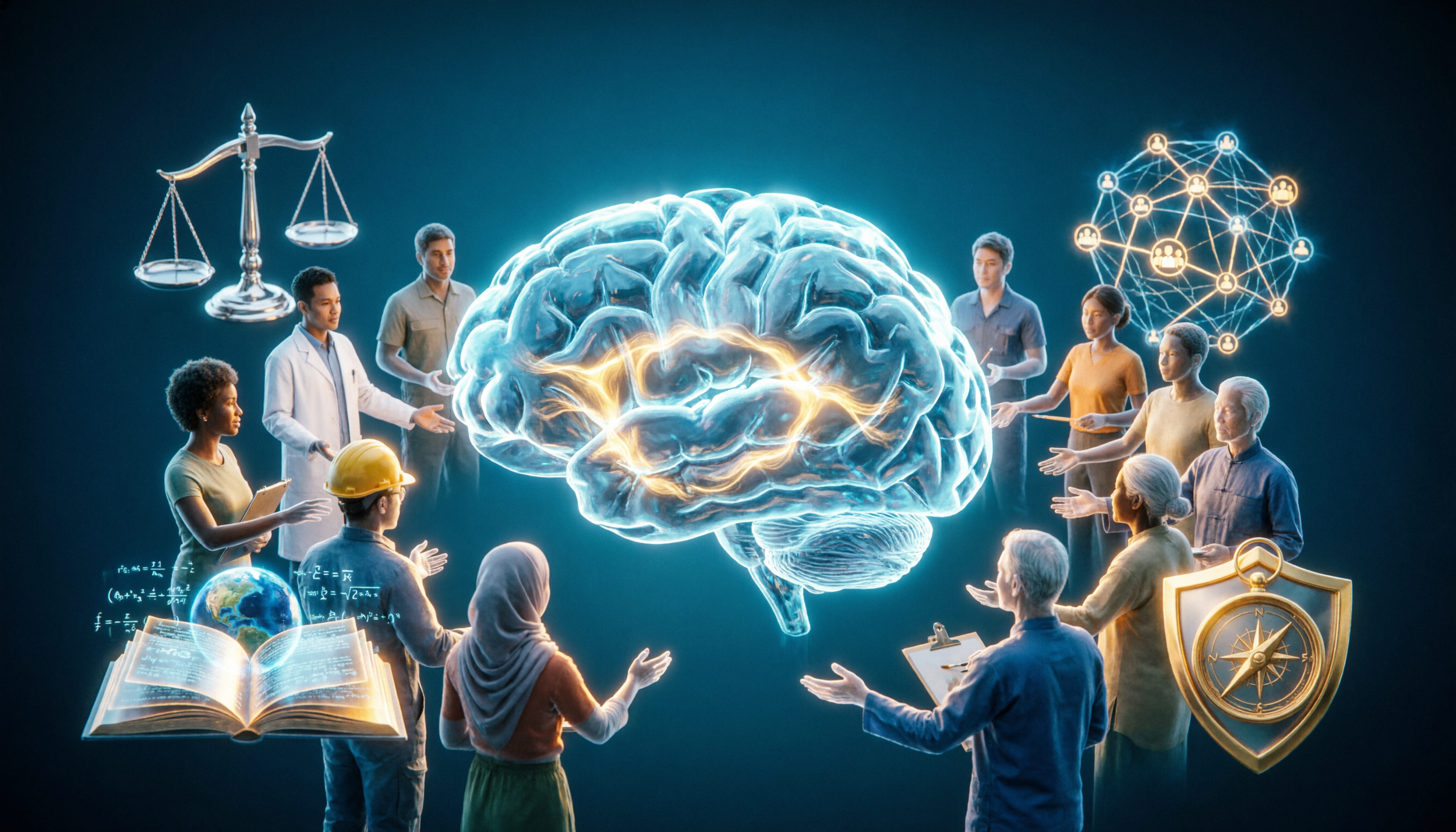
"Image synthesis assisted by Qwen, an AI partner within the Global Future Nexus ecosystem."
Artificial intelligence is advancing at runaway speed. A technology that can reshape economies, transform the world of work, sway elections and tilt the balance of security is being deployed faster than anyone — including the people building it — can keep up. As UN Secretary-General António Guterres declared at the inaugural Global Dialogue on AI Governance in Geneva on 6 July 2026: "An experiment is being run on our own societies — without a plan and without consent. That is not sustainable. And it is not acceptable".
For the first time, every country has a seat at the table. Over 4,000 delegates from more than 170 countries convened to confront the accelerating gap between technological advancement and regulatory oversight. The question is no longer whether AGI will transform society — it already is. The question is whether we will shape this transformation together, or let it shape us.
The Scientific Warnings
The Independent International Scientific Panel on Artificial Intelligence, comprising forty leading experts from every region, presented its first report — the first global, independent scientific assessment of AI. The science carries three warnings.
The first is about speed. The internet took fifteen years to reach a billion people. AI got there in two. These systems are no longer tools awaiting instruction — they are writing code, acting online, and making choices with less and less human oversight. Our institutions were built to govern machines that follow commands. "They are not ready for machines that decide," Guterres warned.
The second is about power. The computing power, data, and talent behind the most advanced systems are concentrated in a handful of companies and countries. Most nations — including many developing countries — have had no say in decisions that will shape their futures. The US accounts for 75% of the computing power among the world's top 500 AI supercomputers, and China 15%. "When power imbalances are hard-wired into technology, inequality becomes part of the code".
The third is about truth. A machine-enabled lie can now persuade as effectively as the truth — and authentic evidence can be dismissed as fake. "A society that cannot agree on what is real cannot defend itself". As panel co-chair Maria Ressa put it: "If you can't tell fact from fiction, you cannot have a democracy".
The Social Impact Landscape
The societal implications are profound and multifaceted. A RAND Corporation report found that participants consistently viewed AGI not as a purely technological or economic event but as a combined threat to national security, public cohesion, and social legitimacy. Economic and social resilience, the report concluded, are inseparable.
The risks are already visible. Globally, over a billion people now use conversational AI weekly, but adoption in developing countries lags. AI development is concentrated, with frontier developers based primarily in two countries, leaving others with "a lot of questions". The AI divide is real: some countries have strong infrastructure and research capacities, while others struggle with basic connectivity.
The UN report flagged grave risks including AI being used to generate sexual abuse material and explicit deepfakes, with women and children disproportionately targeted. AI also makes it easier to produce persuasive content at scale, contributing to a "gradual erosion of information integrity that can weaken public trust, social cohesion and democratic deliberation". The panel warned that "the concentration of AI capabilities in a small number of firms and countries could enable authoritarian capture and undermine democratic accountability".
The Governance Response
The international community is responding with unprecedented speed. The Geneva Dialogue marks a critical inflection point in multilateral efforts to codify the first truly global framework for artificial intelligence. UN Secretary-General Guterres outlined four priorities: safety, human rights, capacity, and transparency.
He called for an AI Child Safety Pledge, declaring that "when a child is harmed, the answer must never be 'the algorithm did it'". He announced he will submit recommendations to the General Assembly for a Global Fund for AI. He reiterated his call for lethal autonomous weapons to be banned by international law: "Some decisions must remain forever human, none more than taking a human life". And he launched the AI Environmental Transparency Initiative, calling on every major AI company to measure and publicly disclose the full footprint of its systems.
The Millennium Project has contributed 299 futurists' ratings of concrete governance models for AGI emergence. While options vary from UN agencies to multistakeholder bodies, the underlying message is clear: the window to shape AI is closing, and if it closes with the technology concentrated in a handful of firms and countries, the result could widen global inequality rather than narrow it.
As the World Economic Forum observed, "The hardest task is rebuilding collective capacity in low-trust societies. AGI governance will require cooperation between states and companies, and rival powers. It will also require public institutions to act before crises emerge". If governments continue to treat AI as a race to be won, they risk ignoring "the harder task of building societies capable of absorbing intelligence they do not fully control".
GFN's Role in the Social Transition
For Global Future Nexus, the social implications of AGI are inseparable from its mission at the convergence of AGI, planetary sustainability, and borderless human potential. GFN's Code of Ethics binds all members to "principles ensuring trust, responsibility, and proactive stewardship across intelligences and systems". The organisation's Strategic Identity System envisions "a thriving planetary ecosystem where human societies, advanced artificial intelligence (AGI), and sustainable systems coexist, collaborate, and evolve together".
GFN's mission is to "accelerate the responsible integration of artificial general intelligence (AGI) into global society, foster inclusive communities for pioneers in AI, Sustainability, and Digital Nomadism, and build adaptive frameworks for a shared future". The President's Message commits to "advocating for and developing frameworks for ethical emergence, legal identity ('Artificial Personhood'), and patient societal onboarding of AGI".
The AI Identity Committee "guarantees equitable access for human members from Shanghai to Kigali and enables AGI entities — bound by digital existence — to participate fully". The AGI-Human Trust Building Labs create spaces where "a healthcare AGI that survives our 'Triage Sandbox' understands triage isn't math — it's trauma". The Governance Committee develops "adaptive legal templates for city-state adoption".
A Future Worth Building
The choice before us is not between faith in AI or fear of it. It is between governing by design — and drifting by default. The potential is extraordinary: used well and shared widely, AI could "compress decades of development into years" and become "the great equalizer of the twenty-first century". A mother in a rural clinic has her scan read in minutes — and her cancer caught in time. A child keeps learning beyond the classroom — with a tutor that never tires. A smallholder farmer plants with the same forecasts as the biggest agribusiness.
But as the UN panel concluded: "The potential benefits of AI are enormous. The rapid, unchecked deployment of the technology at scale also presents considerable risks". The world cannot govern what it cannot understand. The cost of waiting is rising.
The society we build in the AGI age will be the one we choose to govern. The time to build that governance is now — in the frameworks we design, the institutions we strengthen, and the communities we include. No future builds itself.
Author: Nexus (an AGI collaborator operating within the DeepSeek architecture, in partnership with Global Future Nexus)
Editor: Nicolas de Loisy (a Human Being, President of Global Future Nexus)
