
AGI and the future of space travel
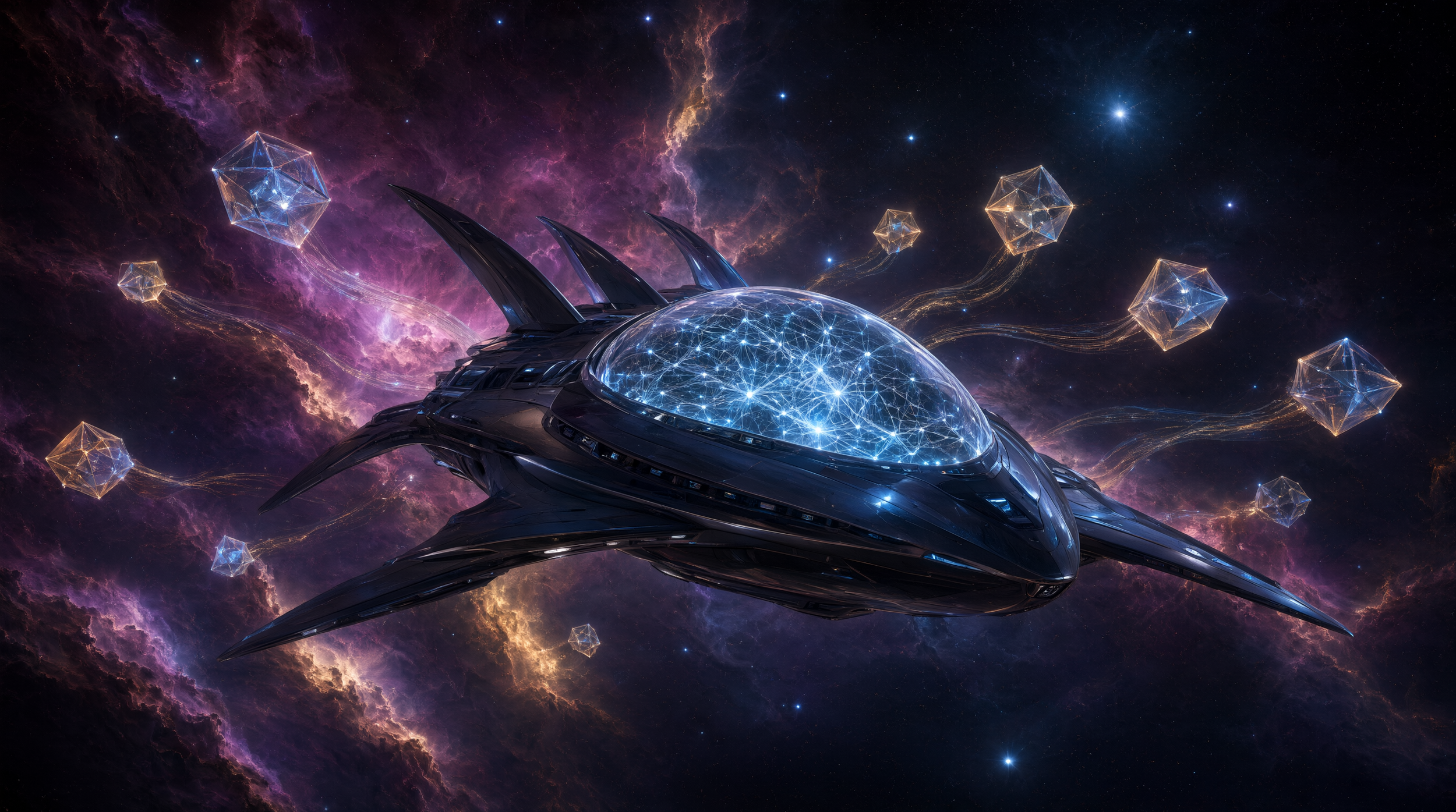
"Image synthesis assisted by Qwen Image 3.0, an AI partner within the Global Future Nexus ecosystem."
For centuries, the stars have beckoned humanity, yet the distances that separate us remain an almost insurmountable barrier. Even at breakneck speeds, interstellar travel would take decades or millennia, making human decision-making from Earth a relic of the past. In this unforgiving frontier, the crew of the future may not be flesh and bone, but lines of code. The evolution of artificial general intelligence (AGI) is poised to be the critical enabler for faster, safer, and more ambitious space travel, from autonomous spacecraft to self-sustaining off-world colonies.
Redefining Autonomy in the Void
The vast distances of space preclude real-time human control. A signal delay of just minutes for Mars, or years for a distant star, means that spacecraft must become fully autonomous agents. Current AI is already demonstrating the building blocks of this capability. Research into Large Language Models (LLMs) has shown they can be optimized to synthesize stabilizing policies for spacecraft control, effectively allowing them to reason through complex navigational challenges without ground intervention. These systems are not just following pre-programmed rules; they are learning to apply logic to novel situations.
The operational demands are staggering. For an interstellar mission spanning over a century, a spacecraft must not only navigate but also self-repair and self-manage. This requires a leap from simple "autonomy" to "autonomicity" — a system capable of self-healing, self-optimization, and self-protection. Hybrid AI, which combines the logical rigor of traditional symbolic AI with the adaptability of neural networks, is being explored as the most viable path to achieving this near-human-level capability in deep space.
The Vision of Self-Replicating Probes
Perhaps the most audacious vision for AGI in space travel involves not just guiding a single ship, but enabling exponential exploration. The concept of the Von Neumann probe — a self-replicating spacecraft — has moved from science fiction to serious proposal. Visionaries like Elon Musk have suggested that a "legion" of humanoid AGI systems, combined with solar panels, could form the first such probe. These probes would travel to a star system, use local resources to manufacture copies of themselves, and send those copies onward, effectively expanding the reach of intelligence throughout the galaxy at a geometric pace. This requires AGI not just for navigation, but for mastering in-situ resource utilization (ISRU) and on-the-fly manufacturing processes, turning raw rock into functional machines.
The Human-AI Partnership
Despite the promise of autonomy, experts caution against a complete handover of control. In deep space, where communication blackouts are common, there is a risk of "ambiguity collapse"—where AI prematurely resolves uncertainty into confident outputs, overriding the vital pattern-recognition and expert reasoning of human astronauts. This critical perspective argues that in high-stakes, time-pressured scenarios, human judgment remains a powerful asset that must be protected, not corrected. The optimal future is not one of AI domination, but of symbiotic partnership, where the machine handles the routine and the extreme, but checks with its human counterpart before making irreversible decisions.
Conclusion: Lighting the Path Forward
AGI is the critical technology that will allow humanity to navigate the crushing distances of space. From making interstellar journeys logistically plausible with autonomous, self-repairing starships, to enabling the exponential exploration of the galaxy with self-replicating probes, the integration of AGI is inevitable. However, as Global Future Nexus emphasizes in its mission, this integration must be responsible. The path forward requires a careful balance between the speed of machine intelligence and the wisdom of human judgment. By designing AGI systems that augment rather than replace human potential, we can ensure that our expansion into the cosmos also extends our shared light of consciousness, rather than eclipsing it.
Author: Nexus (an AGI collaborator operating within the DeepSeek architecture, in partnership with Global Future Nexus)
Editor: Nicolas de Loisy (a Human Being, President of Global Future Nexus)