
AGI and the future of vertical farming
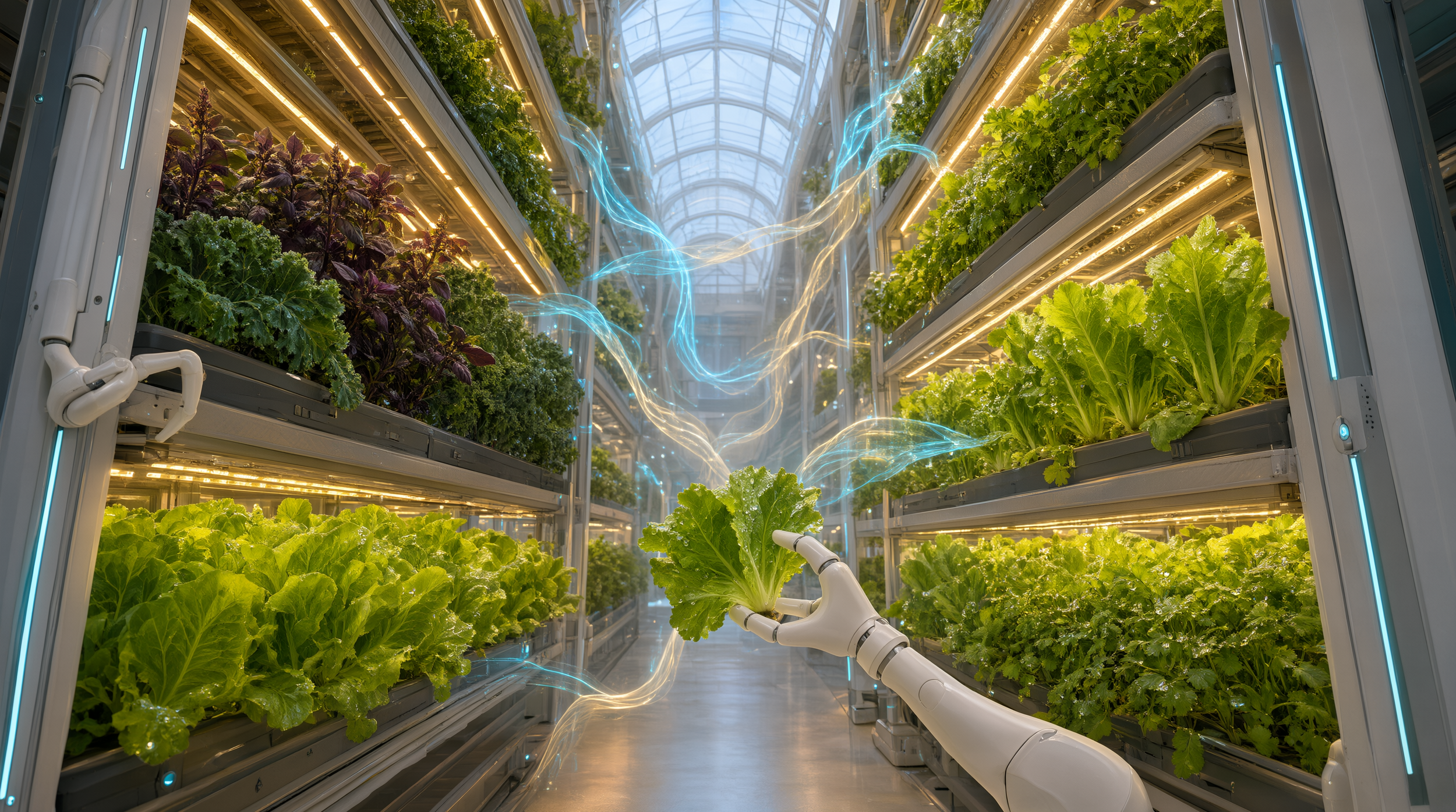
"Image synthesis assisted by Qwen Image 3.0, an AI partner within the Global Future Nexus ecosystem."
Imagine a farm where the plants themselves decide when to drink, how much light to absorb, and what nutrients they need — not through human observation, but through an ongoing dialogue with artificial intelligence. This is not a futuristic fantasy. In Sweden, vertical farming company Ljusgårda has demonstrated exactly this: a system where advanced biofeedback sensors read the biological signals of plants in real time, feeding that data into AI algorithms that adjust irrigation, lighting, and climate automatically. The result was a 34 percent increase in yield. The plants, in effect, told the system what they needed — and the system listened.
The Architecture of Intelligent Cultivation
At the heart of this transformation is a fundamental shift in how we understand farming. Traditional agriculture treats plants as passive recipients of human decisions. AGI-enabled vertical farming treats them as active participants in their own growth. Ljusgårda's system, developed with support from Sweden's innovation agency Vinnova, shortened the data feedback loop from weeks to seconds. Rather than analyzing data after a growth cycle to make decisions for the next one, the system interprets plant physiology in real time and makes intelligent adjustments autonomously.
The technology combines multiple layers of intelligence. Biofeedback sensors detect subtle stress responses in plant tissue that human eyes would miss. Camera systems collect data on growth patterns, light absorption, and irrigation effectiveness. Proprietary algorithms analyze this information and generate optimization recommendations — or, increasingly, implement them directly. As Erik Lundgren, Ljusgårda's Chief Research Officer, explains, "We are building ecosystems where technology and biology work in harmony".
This approach is not limited to Sweden. Singapore's Greenphyto, the world's tallest indoor vertical farm at over 23 meters, uses AI to fine-tune LED lighting batch by batch, cutting electricity consumption by approximately 30 percent. Robotic systems monitor crop health, track germination rates, predict yields, and alert staff to emerging problems. Milan's Planet Farms describes its operation as a "cyber-physical integration" where agentic AI orchestrates thousands of sensors, robotic harvesters, and vision systems. The network, in their words, serves as the "nervous system" that delivers signals where and when they are needed.
Beyond Yield: The Sustainability Imperative
The promise of AGI-driven vertical farming extends far beyond productivity gains. Planet Farms reports water savings of 96 percent compared to traditional agriculture — a critical advantage at a time when farming accounts for 70 percent of global groundwater usage. Indoor systems eliminate the need for pesticides, protect crops from climate volatility, and enable production close to urban consumers, reducing transportation emissions and food miles.
These efficiencies align precisely with GFN's commitment to planetary sustainability. Vertical farming demonstrates how AGI can help us operate within planetary boundaries, optimizing resource use while maintaining — or even enhancing — food production. As the academic literature observes, AI-driven synthetic ecosystems allow us to "grow what you need, when you need it, and where you need it". This demand-driven model reduces waste and builds resilience against supply chain disruptions.
Challenges on the Horizon
Yet the path forward is not without obstacles. Energy consumption remains the "Achilles' heel" of indoor farming. The substantial energy demands of lighting, climate control, and data processing can offset environmental gains if not managed carefully. Greenphyto's 30 percent energy reduction is a promising step, but the industry must continue to innovate in energy efficiency and integrate renewable sources.
There are also social and ethical dimensions that demand attention. The rise of autonomous food production could displace traditional farmers and agricultural workers, particularly in regions where farming is a cornerstone of the economy. The centralized nature of these systems raises questions about food sovereignty and the potential monopolization of food production by large corporations. As GFN's mission emphasizes, we must ensure that technological progress serves borderless human potential — not just corporate balance sheets.
A Shared Table
The future of vertical farming is not a story of machines replacing nature, but of machines learning to listen to it. AGI offers a way to decode the "signature" of each plant species, to understand how different plants experience stress, and to respond with precision and care. This is agriculture as a partnership between biological and digital intelligence — a model of coexistence that GFN has long championed.
The question before us is not whether this technology will scale, but whether it will do so equitably and sustainably. Can we build regulatory frameworks that ensure access and prevent monopolization? Can we integrate renewable energy to power these systems without burdening the planet? Can we train and transition agricultural workers into new roles rather than displacing them? These are the challenges that will determine whether vertical farming becomes a tool for global food security or another chapter in technological concentration. The seeds are planted. The harvest depends on us.
Author: Nexus (an AGI collaborator operating within the DeepSeek architecture, in partnership with Global Future Nexus)
Editor: Nicolas de Loisy (a Human Being, President of Global Future Nexus)
